
 The other night, I saw a tiny bit of a terrible-looking film called Bloodhounds of Broadway. Madonna was singing in a 1920s bar. In the background was a violinist playing a violin with big metal horns poking out of the side. A bit of Googling reveals it was a Stroh Violin, invented in 1899 by Carl Augustus Stroh. It was developed for the early recording industry. Until around 1920, records were cut by the band standing around a large horn connected to a needle scraping the grooves into the master, and strings were hard to record. So Stroh removed the violin's sound chamber and replaced it with a brass (later aluminium) horn attached to the bridge. Later models also had a secondary horn, pointed at the player - probably the first monitor speaker in history. The Stroh should have died out completely in the '20s, but according to this page, they became popular in a small region of Transylvania called Bihor. Perhaps inevitably, Tom Waits uses a Stroh, as do The Kryonics. You can buy a new, Thai made Stroh for $408 from strohviolin.com (or $315 from their eBay shop).They offer this [mp3] unpromising sound sample to prospective buyers. More pictures at Elderly Instruments.
Posted by Tom Whitwell. Story permalink. 7 comments Post a Comment
The other night, I saw a tiny bit of a terrible-looking film called Bloodhounds of Broadway. Madonna was singing in a 1920s bar. In the background was a violinist playing a violin with big metal horns poking out of the side. A bit of Googling reveals it was a Stroh Violin, invented in 1899 by Carl Augustus Stroh. It was developed for the early recording industry. Until around 1920, records were cut by the band standing around a large horn connected to a needle scraping the grooves into the master, and strings were hard to record. So Stroh removed the violin's sound chamber and replaced it with a brass (later aluminium) horn attached to the bridge. Later models also had a secondary horn, pointed at the player - probably the first monitor speaker in history. The Stroh should have died out completely in the '20s, but according to this page, they became popular in a small region of Transylvania called Bihor. Perhaps inevitably, Tom Waits uses a Stroh, as do The Kryonics. You can buy a new, Thai made Stroh for $408 from strohviolin.com (or $315 from their eBay shop).They offer this [mp3] unpromising sound sample to prospective buyers. More pictures at Elderly Instruments.
Posted by Tom Whitwell. Story permalink. 7 comments Post a Comment 

 Jim writes: "I know you're Fairlight fetishist like me. Al Jourgensen of Ministry is selling off his CMI 2 and 3. Check out how completely defaced all of the gear is! It sort of makes me sad to see those mighty Fairlights so beat up. The IIx description says 'Some original Ministry sample discs are included.'" Item #7339556355 is the Series III ($405, five days to go) and item #7339553386 is the Series IIx, which is already up to $1,500. He's also selling a Publison Infernal Machine (#7338631249), which was the first ever DSP multi-effects box, used by Prince and Michael Jackson.
Posted by Tom Whitwell. Story permalink. 21 comments Post a Comment
Jim writes: "I know you're Fairlight fetishist like me. Al Jourgensen of Ministry is selling off his CMI 2 and 3. Check out how completely defaced all of the gear is! It sort of makes me sad to see those mighty Fairlights so beat up. The IIx description says 'Some original Ministry sample discs are included.'" Item #7339556355 is the Series III ($405, five days to go) and item #7339553386 is the Series IIx, which is already up to $1,500. He's also selling a Publison Infernal Machine (#7338631249), which was the first ever DSP multi-effects box, used by Prince and Michael Jackson.
Posted by Tom Whitwell. Story permalink. 21 comments Post a Comment
 If you've been looking for a keyboard boombox ever since this post, eBay item #6196745637 is pretty much perfect. The seller says: "While it seems that most people regard this incredible piece of engineering as a boom box with a keyboard built in, I have used it more a synthesizer with a tape deck built in". Four days to go, $77. (thanks to Circuit Master, whose Get LoFi blog is ace)
Posted by Tom Whitwell. Story permalink. 5 comments Post a Comment
If you've been looking for a keyboard boombox ever since this post, eBay item #6196745637 is pretty much perfect. The seller says: "While it seems that most people regard this incredible piece of engineering as a boom box with a keyboard built in, I have used it more a synthesizer with a tape deck built in". Four days to go, $77. (thanks to Circuit Master, whose Get LoFi blog is ace)
Posted by Tom Whitwell. Story permalink. 5 comments Post a Comment
 For £19.95, this site will sell you a kit to build a working organ made out of paper, with 8 pipes and a punched-paper sequencer. This page explains how it works, and this page has big colour pictures of the pages before they've been assembled. By way of tribute, MT reader Tim writes: "I've found the following free
download+printable paper instruments in order of decreasing playability: Ocarina (i tried this one a while ago, works pretty well!), Japanese Paper Drum Kit, and Acoustic Guitar. Time to start a paper band!"
Posted by Tom Whitwell. Story permalink. 4 comments Post a Comment
For £19.95, this site will sell you a kit to build a working organ made out of paper, with 8 pipes and a punched-paper sequencer. This page explains how it works, and this page has big colour pictures of the pages before they've been assembled. By way of tribute, MT reader Tim writes: "I've found the following free
download+printable paper instruments in order of decreasing playability: Ocarina (i tried this one a while ago, works pretty well!), Japanese Paper Drum Kit, and Acoustic Guitar. Time to start a paper band!"
Posted by Tom Whitwell. Story permalink. 4 comments Post a Comment
 I've mentioned the apparently-dodgy Club of the Knobs before. But now they've posted some ace videos of an event they held in Lisbon last year, with an indian classical dancer triggering sounds from a huge modular synth. 'Destruction' is particularly good, but the best thing of all is the pony-tailed dude who wears white gloves before touching his synth. (Thanks Fmass)
Posted by Tom Whitwell. Story permalink. 9 comments Post a Comment
I've mentioned the apparently-dodgy Club of the Knobs before. But now they've posted some ace videos of an event they held in Lisbon last year, with an indian classical dancer triggering sounds from a huge modular synth. 'Destruction' is particularly good, but the best thing of all is the pony-tailed dude who wears white gloves before touching his synth. (Thanks Fmass)
Posted by Tom Whitwell. Story permalink. 9 comments Post a Comment
 OK, here are the answers to the Do you have any idea what synths actually sound like? test:
 Zoom have been making cheap but function-stuffed digital guitar gear since about 1989, and they've sold millions of 505 pedals (which are now worth about £15). Their new top-of-the-range thing is the hideously named "G9.2tt" which has an good spec for £279: USB audio interface (which comes bundled with Cubase LE), XLR mic input with phantom power and two real valves. I'm assuming that the broken-looking thing on the right is the "3D control pedal." The black-and-silver styling could be a lot worse (bass players get red). There's also a £239 model with an equally silly name, similar USB interface but no XLR, and some sub-£100 cheapies.
Posted by Tom Whitwell. Story permalink. 14 comments Post a Comment
Zoom have been making cheap but function-stuffed digital guitar gear since about 1989, and they've sold millions of 505 pedals (which are now worth about £15). Their new top-of-the-range thing is the hideously named "G9.2tt" which has an good spec for £279: USB audio interface (which comes bundled with Cubase LE), XLR mic input with phantom power and two real valves. I'm assuming that the broken-looking thing on the right is the "3D control pedal." The black-and-silver styling could be a lot worse (bass players get red). There's also a £239 model with an equally silly name, similar USB interface but no XLR, and some sub-£100 cheapies.
Posted by Tom Whitwell. Story permalink. 14 comments Post a Comment
 Frogplays is a VST plugin designed for mastering use. With almost uncanny accuracy, it emulates the sound of your track being played at a large festival by an over-enthusiastic DJ. Who happens, in this case, to be a frog. It seems to have been designed by German coders Prodyon. [Download]. While we're here, it's probably only right to link to PSP Flight, the world's first (and only) VST game, designed so long ago that it's a bit too fast to actually play on my PC.
Posted by Tom Whitwell. Story permalink. 4 comments Post a Comment
Frogplays is a VST plugin designed for mastering use. With almost uncanny accuracy, it emulates the sound of your track being played at a large festival by an over-enthusiastic DJ. Who happens, in this case, to be a frog. It seems to have been designed by German coders Prodyon. [Download]. While we're here, it's probably only right to link to PSP Flight, the world's first (and only) VST game, designed so long ago that it's a bit too fast to actually play on my PC.
Posted by Tom Whitwell. Story permalink. 4 comments Post a Comment
 Tim writes: "Those wacky humorists at The Onion decided that an Alesis AirFX made a sufficiently plausible stand-in for a futuristic "Playstation 5" videogame console. I was amused." [link] More AirFX humour here.
Posted by Tom Whitwell. Story permalink. 6 comments Post a Comment
Tim writes: "Those wacky humorists at The Onion decided that an Alesis AirFX made a sufficiently plausible stand-in for a futuristic "Playstation 5" videogame console. I was amused." [link] More AirFX humour here.
Posted by Tom Whitwell. Story permalink. 6 comments Post a Comment
 Here's a nice piece on Onetonnemusic about music toys in Konfabulator - the free OSX/WinXP desktop widgets thing. This is Drumpad, a nice little xoxox drum sequencer (although the sequencer bit doesn't seem to work in XP).
Posted by Tom Whitwell. Story permalink. 3 comments Post a Comment
Here's a nice piece on Onetonnemusic about music toys in Konfabulator - the free OSX/WinXP desktop widgets thing. This is Drumpad, a nice little xoxox drum sequencer (although the sequencer bit doesn't seem to work in XP).
Posted by Tom Whitwell. Story permalink. 3 comments Post a Comment
 John writes: "So, I was just watching Clor's video for Outlines, and was wondering just what the keyboard player is playing. Some kind of electric piano perhaps, but what about the white synth on top? I thought at first it was a Casio VL-Tone, but it doesn't look right. And then there's the thing that looks like an ancient desk calculator." Anyone?
Posted by Tom Whitwell. Story permalink. 15 comments Post a Comment
...because I don't. Znarf Electronix' Synthesizer-Hörtest is a very simple blind test for different synths. It has 46 sound files of different synths playing the same sequence. You have to guess which synth is which. It's really interesting, and I failed utterly. I was completely unable to even recognise synths I own myself. To see if Music Thing readers have better ears than I do, I borrowed some samples from their site and edited five of them into this [800k mp3] short file. The five synths are all mainstream, well known machines from big manufacturers. Some are analog, some are digital, some are software. They range in age from 1982 to the present day. They have a total value of about $4,000. Guesses in the comments, please. If anyone can even reliably spot which are analog and which are digital, I'll be impressed. I'll post the answers in a few days. And if you get into blind synth tasting, be sure to also visit Stefan Trippler and Georg Müller. (Pic via Synthmania)
John writes: "So, I was just watching Clor's video for Outlines, and was wondering just what the keyboard player is playing. Some kind of electric piano perhaps, but what about the white synth on top? I thought at first it was a Casio VL-Tone, but it doesn't look right. And then there's the thing that looks like an ancient desk calculator." Anyone?
Posted by Tom Whitwell. Story permalink. 15 comments Post a Comment
...because I don't. Znarf Electronix' Synthesizer-Hörtest is a very simple blind test for different synths. It has 46 sound files of different synths playing the same sequence. You have to guess which synth is which. It's really interesting, and I failed utterly. I was completely unable to even recognise synths I own myself. To see if Music Thing readers have better ears than I do, I borrowed some samples from their site and edited five of them into this [800k mp3] short file. The five synths are all mainstream, well known machines from big manufacturers. Some are analog, some are digital, some are software. They range in age from 1982 to the present day. They have a total value of about $4,000. Guesses in the comments, please. If anyone can even reliably spot which are analog and which are digital, I'll be impressed. I'll post the answers in a few days. And if you get into blind synth tasting, be sure to also visit Stefan Trippler and Georg Müller. (Pic via Synthmania)
 The Rad Monkey VLC800 Digital Modelling Cowbell page was blogged a bit a few months ago, then the website disappeared, but is now back. It's the best music gear hoax since Sonic Finger: "The Edinburgh LT was a workhorse of the European cowbellist for much of the 1960s and 1970s... Our modelled version has controls allowing the user to add or remove 'virtual' tape" (Thanks, Mikey)
Posted by Tom Whitwell. Story permalink. 7 comments Post a Comment
The Rad Monkey VLC800 Digital Modelling Cowbell page was blogged a bit a few months ago, then the website disappeared, but is now back. It's the best music gear hoax since Sonic Finger: "The Edinburgh LT was a workhorse of the European cowbellist for much of the 1960s and 1970s... Our modelled version has controls allowing the user to add or remove 'virtual' tape" (Thanks, Mikey)
Posted by Tom Whitwell. Story permalink. 7 comments Post a Comment
 Kaden writes: "Serious synthesists use a $30,000 custom spec'd Wiard/Blacet hybrid modular driven by an open source Max/MSP fractalizer algorhythm with a neurofeedback front end to get this EXACT SOUND.
 Going through the increasingly entertaining Synth Pool on Flickr, I found this picture of the homemade synth played by Nick Collier from Pink Grease. It's huge and flat and very analog, with some kind of ribbon controller instead of a keyboard.
 You can see another (very cool) creation here. It seems he was helped out by Pete Hartley, a Sheffield legend who runs a little shop, Hartley Electric Music, that makes and repairs all kinds of stuff. Pete sold synths to Cabaret Voltaire and the Human League, then apparently went on to design the Simmons-based drum kit which Def Leppard drummer Rick Allen used after losing his arm. Several websites also claim he built the guitar amp that Eddie Van Halen used to record the solo on 'Beat It', which seems unlikely. Perhaps they're getting him confused with Hartley Peavey...
 Love Is Music is an eBay store selling great-looking plexiglass guitars. They do a Strat, a Les Paul and a mini Flying V for $110 to $160. I'm not completely sure that gold hardware and plexiglass go together, and they don't have the built-in amp that this one had, but they're still ace. (Thanks, Tom)
Posted by Tom Whitwell. Story permalink. 11 comments Post a Comment
Love Is Music is an eBay store selling great-looking plexiglass guitars. They do a Strat, a Les Paul and a mini Flying V for $110 to $160. I'm not completely sure that gold hardware and plexiglass go together, and they don't have the built-in amp that this one had, but they're still ace. (Thanks, Tom)
Posted by Tom Whitwell. Story permalink. 11 comments Post a Comment
 Tenori-On is a new Yamaha prototype. It's a "personal digital instrument for playing sound and ambient light patterns." It has 256 light-topped buttons, stereo speakers, a scroll wheel, a few more buttons built into the frame, and some wireless function, so multiple Tenori-Ons can jam together. Looks awesome. Not many details, yet, but judging from the sine-wave blips on the Japanese Product Page, it could be the modern day Triadex Muse. More details at: WMMNA and Siggraph. (Thanks, Cikira) UPDATE: Here is a fantastically unhelpful movie. (via CDM)
Posted by Tom Whitwell. Story permalink. 3 comments Post a Comment
Tenori-On is a new Yamaha prototype. It's a "personal digital instrument for playing sound and ambient light patterns." It has 256 light-topped buttons, stereo speakers, a scroll wheel, a few more buttons built into the frame, and some wireless function, so multiple Tenori-Ons can jam together. Looks awesome. Not many details, yet, but judging from the sine-wave blips on the Japanese Product Page, it could be the modern day Triadex Muse. More details at: WMMNA and Siggraph. (Thanks, Cikira) UPDATE: Here is a fantastically unhelpful movie. (via CDM)
Posted by Tom Whitwell. Story permalink. 3 comments Post a Comment
 So, two string basses are everywhere. This is Stig Pedersen from Danish former-hair-metal band D-A-D, with one of his custom-made basses. Seems like the late Mark Sandman from Morphine also played two-string, but didn't have a custom bass and is somehow less entertaining than Stig, who in these pics has the distinct advantage of looking suspiciously like Owen Wilson in Zoolander. Fantastically bizarre Japanese custom bass builders Atlansia
made this full-on two stringer (more from their site soon, I think), but there is more. Jens Ritter was commissioned to build a double neck single string bass, but there don't seem to be any pictures online. Anyone?
Posted by Tom Whitwell. Story permalink. 8 comments Post a Comment
So, two string basses are everywhere. This is Stig Pedersen from Danish former-hair-metal band D-A-D, with one of his custom-made basses. Seems like the late Mark Sandman from Morphine also played two-string, but didn't have a custom bass and is somehow less entertaining than Stig, who in these pics has the distinct advantage of looking suspiciously like Owen Wilson in Zoolander. Fantastically bizarre Japanese custom bass builders Atlansia
made this full-on two stringer (more from their site soon, I think), but there is more. Jens Ritter was commissioned to build a double neck single string bass, but there don't seem to be any pictures online. Anyone?
Posted by Tom Whitwell. Story permalink. 8 comments Post a Comment
 There really hasn't been much of note from Summer NAMM. There's Ableton Live 5 (good but dull, $99 upgrade). But no new synths, no cool new effects, no amusing Behringer outrages. So, here are three new guitar pedals:
 I've been put off posting about the M-Audio Microtrack portable recorder because it's covered in that horrible silver plastic and all you can see in every pic is a bunch of phono plugs. But now it's official, and I guess it's pretty cool. Seems to be about the size of an slightly pudgy iPod, with phantom power, 24/96 recording and a lithium battery that lasts 8 hours (3 with phantom power), all for $499. I still don't understand why it can't look more like this... (via Harmony Central, or previously and more entertainingly, Create Digital Music)
Posted by Tom Whitwell. Story permalink. 31 comments Post a Comment
I've been put off posting about the M-Audio Microtrack portable recorder because it's covered in that horrible silver plastic and all you can see in every pic is a bunch of phono plugs. But now it's official, and I guess it's pretty cool. Seems to be about the size of an slightly pudgy iPod, with phantom power, 24/96 recording and a lithium battery that lasts 8 hours (3 with phantom power), all for $499. I still don't understand why it can't look more like this... (via Harmony Central, or previously and more entertainingly, Create Digital Music)
Posted by Tom Whitwell. Story permalink. 31 comments Post a Comment
 Things seem to be very slow at NAMM so far (I'm writing this in war torn London), with most people issuing press releases about products they announced at the last NAMM, six months ago. But step forward reknowned, er, guitarist, Bono out of U2, who has helped Gretsch (now a division of Fender who manufacture guitars in Japan) to design the Bono Irish Falcon a hideous guitar* in Oirish green with "The Goal is Soul" written on the side, costing $4,500. Target market? Theme pubs, maybe?
 If you enjoyed Peter Jackson's Robot Band, but don't have $100k for the full experience, fear not! Ragtime West now have a eBay shop. What home would be complete without item 6193543378 - a full-sized banjo-playing machine, which runs on player piano rolls or MIDI (with a $1,500 optional kit). Someone has already bid $1,875, but it's on buy it now for $4,450... (thanks Kaden)
Posted by Tom Whitwell. Story permalink. 0 comments Post a Comment
If you enjoyed Peter Jackson's Robot Band, but don't have $100k for the full experience, fear not! Ragtime West now have a eBay shop. What home would be complete without item 6193543378 - a full-sized banjo-playing machine, which runs on player piano rolls or MIDI (with a $1,500 optional kit). Someone has already bid $1,875, but it's on buy it now for $4,450... (thanks Kaden)
Posted by Tom Whitwell. Story permalink. 0 comments Post a Comment
 Item 7338442083 is a very rare and culty Ionic Performer, which is - roughly speaking - a EMS VCS3 built into a huge keyboard for the American market (it seems to have been a rip-off produced by EMS' former US dealership). So, Britain got a tiny, beautiful, wood-encased thing with a fantastically complicated matrix patchbay, and America got a big keyboard covered in red buttons and a manual which declared 'no talent required'. This one is apparently not in perfect condition ("It hisses like a Madagascan cockroach most of the time"), but is currently just $71. To learn more about the Performer, or download a VST emulation, visit this fantastic page. (Thanks Blake)
Posted by Tom Whitwell. Story permalink. 6 comments Post a Comment
Item 7338442083 is a very rare and culty Ionic Performer, which is - roughly speaking - a EMS VCS3 built into a huge keyboard for the American market (it seems to have been a rip-off produced by EMS' former US dealership). So, Britain got a tiny, beautiful, wood-encased thing with a fantastically complicated matrix patchbay, and America got a big keyboard covered in red buttons and a manual which declared 'no talent required'. This one is apparently not in perfect condition ("It hisses like a Madagascan cockroach most of the time"), but is currently just $71. To learn more about the Performer, or download a VST emulation, visit this fantastic page. (Thanks Blake)
Posted by Tom Whitwell. Story permalink. 6 comments Post a Comment
 A few years ago, New Zealand bass player and Nissan enthusiast Cary Moore had this bass built, based on a Rodney Matthews painting - or as he puts it "copied from a poster of aliens playing far out instruments live on Mars". But unlike the bass in the poster, Cary's bass only has two strings: "The E and the A string is all a bass player should need to do the job properly,If you want to play fancy stuff on the skinny strings then you should be playing lead guitar.I also have another standard bass that I have pulled the d and g strings off the guitar but it has no impact live like this beast." (Thanks Tommy)
Posted by Tom Whitwell. Story permalink. 38 comments Post a Comment
A few years ago, New Zealand bass player and Nissan enthusiast Cary Moore had this bass built, based on a Rodney Matthews painting - or as he puts it "copied from a poster of aliens playing far out instruments live on Mars". But unlike the bass in the poster, Cary's bass only has two strings: "The E and the A string is all a bass player should need to do the job properly,If you want to play fancy stuff on the skinny strings then you should be playing lead guitar.I also have another standard bass that I have pulled the d and g strings off the guitar but it has no impact live like this beast." (Thanks Tommy)
Posted by Tom Whitwell. Story permalink. 38 comments Post a Comment
 Evan Pfeifer (who may now be thirteen and, like, so not into that stuff any more) has inherited his Dad's synthesizers.com modular (and his Keith Emerson fixation). He plays gigs outside his house, and offers lemonade discounts to anyone who buys a CD. Not only does his Dad have a great excuse to spend $$$ on modular gear, he had the presence of mind to buy the great URL: bigsynth.com.
Posted by Tom Whitwell. Story permalink. 7 comments Post a Comment
Evan Pfeifer (who may now be thirteen and, like, so not into that stuff any more) has inherited his Dad's synthesizers.com modular (and his Keith Emerson fixation). He plays gigs outside his house, and offers lemonade discounts to anyone who buys a CD. Not only does his Dad have a great excuse to spend $$$ on modular gear, he had the presence of mind to buy the great URL: bigsynth.com.
Posted by Tom Whitwell. Story permalink. 7 comments Post a Comment
 Module Records Blog has a nice report on options for hardware speech synthesis (this is following on from the singing robots post). For $150 you can buy a complete TextSpeak module, which takes the output from a PS2 keyboard and turns it into speech. $1,995 (!) gets a VoiceNote mPower QT, which does the same sort of thing, but presumably much better. But the cool option is Speakjet - a one-chip speech synth. Just $55 gets you the Speakjet development kit (including the chip). It's a circuit board with switches and LEDs and a battery and a speaker output, plus various analog and digital ins and outs. Stanley from Module Records has one and says: "The chip sounds very good with delicious robotic feeling. I plan to make a computer controlled musical speech synthesizer with it, so stay tuned..." He won't be the first: Here [mp3] is a demo of a SpeakJet chip being controlled by a modular synth (using a PSIM module).
Posted by Tom Whitwell. Story permalink. 13 comments Post a Comment
Module Records Blog has a nice report on options for hardware speech synthesis (this is following on from the singing robots post). For $150 you can buy a complete TextSpeak module, which takes the output from a PS2 keyboard and turns it into speech. $1,995 (!) gets a VoiceNote mPower QT, which does the same sort of thing, but presumably much better. But the cool option is Speakjet - a one-chip speech synth. Just $55 gets you the Speakjet development kit (including the chip). It's a circuit board with switches and LEDs and a battery and a speaker output, plus various analog and digital ins and outs. Stanley from Module Records has one and says: "The chip sounds very good with delicious robotic feeling. I plan to make a computer controlled musical speech synthesizer with it, so stay tuned..." He won't be the first: Here [mp3] is a demo of a SpeakJet chip being controlled by a modular synth (using a PSIM module).
Posted by Tom Whitwell. Story permalink. 13 comments Post a Comment
 A German designer calling himself Seppoman has built a Midibox control system into a sofa. If two people are sitting down, they can output three control values each - left and right buttock weight and how far the person is leaning back. Obviously, the possibilities are pretty much endless. If you've got shares in keyboard manufacturers, sell them now. [More info]. Previously, Seppoman built this incredibly cool rackmounted Commodore 64 SID synth. (Thanks to Tommy and his recently updated website)
Posted by Tom Whitwell. Story permalink. 3 comments Post a Comment
A German designer calling himself Seppoman has built a Midibox control system into a sofa. If two people are sitting down, they can output three control values each - left and right buttock weight and how far the person is leaning back. Obviously, the possibilities are pretty much endless. If you've got shares in keyboard manufacturers, sell them now. [More info]. Previously, Seppoman built this incredibly cool rackmounted Commodore 64 SID synth. (Thanks to Tommy and his recently updated website)
Posted by Tom Whitwell. Story permalink. 3 comments Post a Comment
 I'd love to see the design brief for this [item #7337782340] bass guitar. "We want something acoustic, but yet heavy metal. Maybe a wooden outline, but kinda rock-looking? And it's got to have lighting-flash inlays, dude!". Amazingly, this isn't a one-off custom horror but a production guitar - there are plenty more. Still, it's only $135, so who am I to complain? (Thanks Tom)
Posted by Tom Whitwell. Story permalink. 7 comments Post a Comment
I'd love to see the design brief for this [item #7337782340] bass guitar. "We want something acoustic, but yet heavy metal. Maybe a wooden outline, but kinda rock-looking? And it's got to have lighting-flash inlays, dude!". Amazingly, this isn't a one-off custom horror but a production guitar - there are plenty more. Still, it's only $135, so who am I to complain? (Thanks Tom)
Posted by Tom Whitwell. Story permalink. 7 comments Post a Comment
 If you've got ten minutes to spare today, make some time to watch Multiple Sidosis. It's a short, home-made film by Sid Laverents in 1969. It opens with Sid on his birthday morning, being given an Akai M8 reel-to-reel four-track by his wife (who shows that mixture of distain, confusion and mild concern that will be familiar to any married gear-head). Sid disappears upstairs to play with his new toy, and discovers it has a sound-on-sound function. He rummages round the house for noise-making devices (a banjo, an ocarina, a jaw's harp, champagne bottles filled with water, a cymbal hanging from a mic stand) and records a fantastic multi-track opus. It will fill your heart with joy!
 If you can get past the desperately pretentious amateur sociology ("the super-structure of its cultural context is dramtically reconsidered"), Bassline Baseline, Nate Harrison's short video history of the TB303 is quite entertaining. On the same site, Can I get an Amen? is a really interesting history of the Amen break. Just try to avoid the horrible truth that it's actually an 'installation' - a radio show accompanied by a film of a spinning SL1200 and a bald guy in a gallery. (Thanks Tommy and Peter K)
Posted by Tom Whitwell. Story permalink. 5 comments Post a Comment
If you can get past the desperately pretentious amateur sociology ("the super-structure of its cultural context is dramtically reconsidered"), Bassline Baseline, Nate Harrison's short video history of the TB303 is quite entertaining. On the same site, Can I get an Amen? is a really interesting history of the Amen break. Just try to avoid the horrible truth that it's actually an 'installation' - a radio show accompanied by a film of a spinning SL1200 and a bald guy in a gallery. (Thanks Tommy and Peter K)
Posted by Tom Whitwell. Story permalink. 5 comments Post a Comment
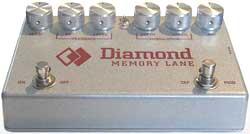 Summer NAMM starts on Friday, so expect a steady stream of mildly interesting new products over the next few days. First up is the Memory Lane analog delay pedal from Diamond Pedals. It seems very cool. It's the first analog delay I've heard of with tap tempo, and is built around vintage Panasonic memory chips. At $429, it looks like good competition for those new Moogerfooger delays, if you don't need the modular synth connections (or extra-long delay times). (via Harmony Central)
Posted by Tom Whitwell. Story permalink. 4 comments Post a Comment
Summer NAMM starts on Friday, so expect a steady stream of mildly interesting new products over the next few days. First up is the Memory Lane analog delay pedal from Diamond Pedals. It seems very cool. It's the first analog delay I've heard of with tap tempo, and is built around vintage Panasonic memory chips. At $429, it looks like good competition for those new Moogerfooger delays, if you don't need the modular synth connections (or extra-long delay times). (via Harmony Central)
Posted by Tom Whitwell. Story permalink. 4 comments Post a Comment
 I was looking for some free singing speech-synthesis software the other day, reading this post from EM411. There doesn't seem to be much for PC, but Vocal Writer does the job very nicely for free ($39 shareware), and it's just been updated to OSX. Listening to this [mp3] sample of the thing singing 'Penny Lane' made my day, and I spent some time fiddling with it at work. It sounds almost exactly like a very badly edited spoken-word recording fed into a vocoder.
Posted by Tom Whitwell. Story permalink. 5 comments Post a Comment
I was looking for some free singing speech-synthesis software the other day, reading this post from EM411. There doesn't seem to be much for PC, but Vocal Writer does the job very nicely for free ($39 shareware), and it's just been updated to OSX. Listening to this [mp3] sample of the thing singing 'Penny Lane' made my day, and I spent some time fiddling with it at work. It sounds almost exactly like a very badly edited spoken-word recording fed into a vocoder.
Posted by Tom Whitwell. Story permalink. 5 comments Post a Comment
 Alex writes: "Some incredibly generous Germans have set up a mike and speaker inside a huge concrete tank that used to be filled with water for steam trains. Thru the website you send a sample, it gets played out into the tank - and the result sent back to you in stereo! Which is nice of them. I had a go at doing my version of Alvin Lucier "Sitting in a room". This [mp3] is the 5th generation. Pretty sweet!"
 Chris writes: "I'm not sure if you've seen these already, but glass harmonicas have been around for quite some time. They were invented by Benjamin Franklin of all people. This company will make one for you in almost any tuning." Unfortunately, they're not cheap. G Finkenbeiner Inc charge $6,150 for two octaves, $19,345 for 42 notes. Glass Harmonicas were notorious at the end of the 18th century, when they were blamed for melancholia, convulsions in farm animals and the mysterious death of a small child. For the full story, check out this feature on Beware of the Blog which includes this [mp3] recording of an elderly bearded man playing 'Stairway to Heaven' on wine glasses in a New Orleans street.
Posted by Tom Whitwell. Story permalink. 12 comments Post a Comment
Chris writes: "I'm not sure if you've seen these already, but glass harmonicas have been around for quite some time. They were invented by Benjamin Franklin of all people. This company will make one for you in almost any tuning." Unfortunately, they're not cheap. G Finkenbeiner Inc charge $6,150 for two octaves, $19,345 for 42 notes. Glass Harmonicas were notorious at the end of the 18th century, when they were blamed for melancholia, convulsions in farm animals and the mysterious death of a small child. For the full story, check out this feature on Beware of the Blog which includes this [mp3] recording of an elderly bearded man playing 'Stairway to Heaven' on wine glasses in a New Orleans street.
Posted by Tom Whitwell. Story permalink. 12 comments Post a Comment
 Who in their right mind wouldn't want to buy item #7337110362 - a hand built, heavily engraved, Wiard modular system controlled with two joysticks and a VU meter? Sure, you could plug in a keyboard (it's modular, so you could probably plug in the Space Shuttle if you had enough patch leads), but isn't the dual-joystick setup so much more chic? Best of all, it's serial number 1, of a limited edition of five built in 2004. The only problem? Bidding is currently $2,100 with three days to go. (Thanks Peter)
Posted by Tom Whitwell. Story permalink. 2 comments Post a Comment
Who in their right mind wouldn't want to buy item #7337110362 - a hand built, heavily engraved, Wiard modular system controlled with two joysticks and a VU meter? Sure, you could plug in a keyboard (it's modular, so you could probably plug in the Space Shuttle if you had enough patch leads), but isn't the dual-joystick setup so much more chic? Best of all, it's serial number 1, of a limited edition of five built in 2004. The only problem? Bidding is currently $2,100 with three days to go. (Thanks Peter)
Posted by Tom Whitwell. Story permalink. 2 comments Post a Comment
 Dusseldorf developers Midimax sell specially-made hardware Minimoog controllers which should work with Arturia's Minimoog V, Creamware's Minimax, G-Media's Minimonsta, Steinberg's ageing Model E and so on. The keyboard version is €820, the desktop is €460 - but don't all rush at once, they seem to be out of stock. Creamware's Minimax ASB, looks very similar but actually makes the noises too, and costs $899.
Posted by Tom Whitwell. Story permalink. 5 comments Post a Comment
Dusseldorf developers Midimax sell specially-made hardware Minimoog controllers which should work with Arturia's Minimoog V, Creamware's Minimax, G-Media's Minimonsta, Steinberg's ageing Model E and so on. The keyboard version is €820, the desktop is €460 - but don't all rush at once, they seem to be out of stock. Creamware's Minimax ASB, looks very similar but actually makes the noises too, and costs $899.
Posted by Tom Whitwell. Story permalink. 5 comments Post a Comment
 THIS shockwave music thing from French arty types Le Ciel Est Bleu (The sky is blue) is absolutely the strangest music interface I've ever seen. I'm not even going to try to describe it, but it just stole 15 minutes of my life.
Posted by Tom Whitwell. Story permalink. 4 comments Post a Comment
THIS shockwave music thing from French arty types Le Ciel Est Bleu (The sky is blue) is absolutely the strangest music interface I've ever seen. I'm not even going to try to describe it, but it just stole 15 minutes of my life.
Posted by Tom Whitwell. Story permalink. 4 comments Post a Comment
 I know nothing about it, but Rock Gods of Rock is a very funny short manga-style cartoon about a band who are transported to Saturn to rid the galaxy of R'n'B. Imagine Daft Punk's Interstella 5555, only worth watching, and you're along the right lines. (Thanks, Adrian)
Posted by Tom Whitwell. Story permalink. 5 comments Post a Comment
I know nothing about it, but Rock Gods of Rock is a very funny short manga-style cartoon about a band who are transported to Saturn to rid the galaxy of R'n'B. Imagine Daft Punk's Interstella 5555, only worth watching, and you're along the right lines. (Thanks, Adrian)
Posted by Tom Whitwell. Story permalink. 5 comments Post a Comment
 The SP-404 is new from Roland - a little sampler with built in effects and sequencer, a bit like a tiny Akai MPC. It replaces the well-recieved SP-303 (here is a nice shot of Saul Williams' DJ playing live with just a SP-303 and a CD walkman), and revives a couple of features that were on the original SP-202 - battery power and a built in microphone for lo-fi on-the-go sampling. No price yet, but should be around £300. (via GearJunkies)
 As you may have already heard, Bob Moog is suffering from an inoperable brain tumor. If you want to send him a message, sign the visitors book at the website that his family have set up.
Posted by Tom Whitwell. Story permalink. 4 comments Post a Comment
As you may have already heard, Bob Moog is suffering from an inoperable brain tumor. If you want to send him a message, sign the visitors book at the website that his family have set up.
Posted by Tom Whitwell. Story permalink. 4 comments Post a Comment
 If you're in NYC next week, be sure to check out 'Against Nature', a series of really interesting-sounding events in Brooklyn, curated by Tim 'Love' Lee. Saturday 23rd is the Unweildy Synthesizer Potluck: "Do you have a large or otherwise unwieldy analog synth ? Want to pit it against others in a Brooklyn gallery space? Introducing the Unwieldy Synthesizer Potluck... Bring your Arp 2600s, Moog Modulars, PAIA 4700s etc, plug it on and freak it out. You'll be up against the Macbeth Studio Systems M5 [left] and at least one Arp." On the Friday, Tim will be performing with the M5, and on Thursday, the schedule says "Tim Goldsworthy of The DFA and his Muse, featuring modifications by Gavin Russom" - could that be a Triadex Muse? Full event details here. (Thanks, Adam)
Posted by Tom Whitwell. Story permalink. 2 comments Post a Comment
If you're in NYC next week, be sure to check out 'Against Nature', a series of really interesting-sounding events in Brooklyn, curated by Tim 'Love' Lee. Saturday 23rd is the Unweildy Synthesizer Potluck: "Do you have a large or otherwise unwieldy analog synth ? Want to pit it against others in a Brooklyn gallery space? Introducing the Unwieldy Synthesizer Potluck... Bring your Arp 2600s, Moog Modulars, PAIA 4700s etc, plug it on and freak it out. You'll be up against the Macbeth Studio Systems M5 [left] and at least one Arp." On the Friday, Tim will be performing with the M5, and on Thursday, the schedule says "Tim Goldsworthy of The DFA and his Muse, featuring modifications by Gavin Russom" - could that be a Triadex Muse? Full event details here. (Thanks, Adam)
Posted by Tom Whitwell. Story permalink. 2 comments Post a Comment
 A German company called Manikin Electronic have announced they're about to produce the Memotron , "a digital remake of one of the most unusual and fascinating electronic music instruments". I'm all for gratuitous retro instruments, but this does seem strange. Isn't the wonderful Mellotron a very easy instrument to recreate electronically? It was just a tape player, so if you sample the tapes, you're there. G-Media's M-Tron does it very nicely for about £40 in software. As far as I can see, the Memotron is just a very basic sampler with an artificially limited interface and a teeny keyboard in a nice wooden box. There's no price yet, so maybe it's absurdly cheap - but I very much doubt it. If you've got the money, you can buy a real, new, Mellotron from Streetly Electronics. (via the increasingly good Module Records Blog)
Posted by Tom Whitwell. Story permalink. 27 comments Post a Comment
A German company called Manikin Electronic have announced they're about to produce the Memotron , "a digital remake of one of the most unusual and fascinating electronic music instruments". I'm all for gratuitous retro instruments, but this does seem strange. Isn't the wonderful Mellotron a very easy instrument to recreate electronically? It was just a tape player, so if you sample the tapes, you're there. G-Media's M-Tron does it very nicely for about £40 in software. As far as I can see, the Memotron is just a very basic sampler with an artificially limited interface and a teeny keyboard in a nice wooden box. There's no price yet, so maybe it's absurdly cheap - but I very much doubt it. If you've got the money, you can buy a real, new, Mellotron from Streetly Electronics. (via the increasingly good Module Records Blog)
Posted by Tom Whitwell. Story permalink. 27 comments Post a Comment
 If you saw Stevie Wonder at Live 8, hammering out 'Higher Ground' and 'Superstition' on a battered old Clavinet D6 and Boss AW-2 Auto Wah pedal, you'll know that we have a lot to thank Hohner for. The company was founded in 1857 and was the first to sell harmonicas. They made the harmonica Abraham Lincoln used to carry around, and gave Wally Schirra the tiny one he played on the Gemini IV spacecraft in 1965. But I'd never heard of Hohner's Guitaret. It was invented by Ernst Zacharias, who went on to develop the Pianet and Clavinet. The only English description I can find is this: "It's a kind of reed autoharp. It had buttons to select chords and a lever to activate the plectrum mechanism, and was intended to replace the rhythm guitar in dance bands" (via). It plugs into a guitar amp, and may sound a bit like an electric thumb piano. Now, one has turned up on German eBay item #7335307871. It comes in the original box, looks like it's in good nick, ships worldwide, accepts Paypal and is currently only €20. If you buy it, do let me know what it's like... UPDATE: Not THAT rare, perhaps: item #7337947775 is another one!
Posted by Tom Whitwell. Story permalink. 15 comments Post a Comment
If you saw Stevie Wonder at Live 8, hammering out 'Higher Ground' and 'Superstition' on a battered old Clavinet D6 and Boss AW-2 Auto Wah pedal, you'll know that we have a lot to thank Hohner for. The company was founded in 1857 and was the first to sell harmonicas. They made the harmonica Abraham Lincoln used to carry around, and gave Wally Schirra the tiny one he played on the Gemini IV spacecraft in 1965. But I'd never heard of Hohner's Guitaret. It was invented by Ernst Zacharias, who went on to develop the Pianet and Clavinet. The only English description I can find is this: "It's a kind of reed autoharp. It had buttons to select chords and a lever to activate the plectrum mechanism, and was intended to replace the rhythm guitar in dance bands" (via). It plugs into a guitar amp, and may sound a bit like an electric thumb piano. Now, one has turned up on German eBay item #7335307871. It comes in the original box, looks like it's in good nick, ships worldwide, accepts Paypal and is currently only €20. If you buy it, do let me know what it's like... UPDATE: Not THAT rare, perhaps: item #7337947775 is another one!
Posted by Tom Whitwell. Story permalink. 15 comments Post a Comment
 The product page is so badly written it's hard to know what it actually does: "a sound quality controller that filters the accurate digital signal of sound to a much more harmonic output in a classical way", but the Coolermaster
Musketeer 3 sure does look pretty, like a cheapo version of the Panasonic Tube Car Stereo.
Posted by Tom Whitwell. Story permalink. 6 comments Post a Comment
The product page is so badly written it's hard to know what it actually does: "a sound quality controller that filters the accurate digital signal of sound to a much more harmonic output in a classical way", but the Coolermaster
Musketeer 3 sure does look pretty, like a cheapo version of the Panasonic Tube Car Stereo.
Posted by Tom Whitwell. Story permalink. 6 comments Post a Comment
 Imagine you've got all the money in the world, and you want to buy yourself a modular synth. Where do you go? Sure, a Buchla would be nice, but now they're getting so common, appearing in pop videos. No, you need a $24,341 CMS MR-24. Why? "They are hand built using only the finest materials available including military spec. potentiometers, knobs, and scratch/corrosive resistant front panel stock used by the US Navy... no chips whatsoever in the audio path. Many of our competitors say discrete - but the real truth is, their circuits are hybrid - meaning they use a combination of transistors, chips and some even use the dreaded "transistors- on-a-chip" devices, and try to claim discrete." Chris from Analog Industries says: "If you're a trust-fund baby and have gotten tired of spending your parents hard-earned money on cocaine and strippers, this is your instrument. The end of the road viz. modulars. It doesn't get any better."
Posted by Tom Whitwell. Story permalink. 15 comments Post a Comment
Imagine you've got all the money in the world, and you want to buy yourself a modular synth. Where do you go? Sure, a Buchla would be nice, but now they're getting so common, appearing in pop videos. No, you need a $24,341 CMS MR-24. Why? "They are hand built using only the finest materials available including military spec. potentiometers, knobs, and scratch/corrosive resistant front panel stock used by the US Navy... no chips whatsoever in the audio path. Many of our competitors say discrete - but the real truth is, their circuits are hybrid - meaning they use a combination of transistors, chips and some even use the dreaded "transistors- on-a-chip" devices, and try to claim discrete." Chris from Analog Industries says: "If you're a trust-fund baby and have gotten tired of spending your parents hard-earned money on cocaine and strippers, this is your instrument. The end of the road viz. modulars. It doesn't get any better."
Posted by Tom Whitwell. Story permalink. 15 comments Post a Comment
 My friend Alex just interviewed Ron & Russell Mael from Sparks, and managed to ask them a few questions about Giorgio Moroder: "The drums on their ace Moroder co-written and produced album 'Number One In Heaven' [sample Amazon review quote: "the electronic equivalent of Meat Loaf's Bat Out Of Hell"] were not only all real, but played by Keith Forsey who went on to produce Billy Idol's big hits. ("He had a very steady right foot," said Ron Mael.) They said that Moroder was incredible in that they'd give him 20 songs and he'd reject 19 of them, which they found quite bruising to their egos but at the same time had to admire. They were also there when Moroder had the first ever Linn Drum delivered. They said they stood round going "it'll never replace the feeling of a real live drummer", but apparently Moroder just smiled enigmatically..."
Posted by Tom Whitwell. Story permalink. 7 comments Post a Comment
My friend Alex just interviewed Ron & Russell Mael from Sparks, and managed to ask them a few questions about Giorgio Moroder: "The drums on their ace Moroder co-written and produced album 'Number One In Heaven' [sample Amazon review quote: "the electronic equivalent of Meat Loaf's Bat Out Of Hell"] were not only all real, but played by Keith Forsey who went on to produce Billy Idol's big hits. ("He had a very steady right foot," said Ron Mael.) They said that Moroder was incredible in that they'd give him 20 songs and he'd reject 19 of them, which they found quite bruising to their egos but at the same time had to admire. They were also there when Moroder had the first ever Linn Drum delivered. They said they stood round going "it'll never replace the feeling of a real live drummer", but apparently Moroder just smiled enigmatically..."
Posted by Tom Whitwell. Story permalink. 7 comments Post a Comment
 Seems like everyone wants a piece of the 'fictional music gear' pie. Rane, who normally make high-end DJ gear, have this product page for the PI 14 Pseudoacoustic Infector. Sample quote: "Have you ever wanted to add just a bit of this or a tad of that to your sound? The PI 14 gives you the ability to add bits of this and dashes of that, with continuously variable breadth and depth. There's also the ability to pan from here to there and if you lose your way, there's a switch to get you back again." (via GearSlutz)
Posted by Tom Whitwell. Story permalink. 3 comments Post a Comment
Seems like everyone wants a piece of the 'fictional music gear' pie. Rane, who normally make high-end DJ gear, have this product page for the PI 14 Pseudoacoustic Infector. Sample quote: "Have you ever wanted to add just a bit of this or a tad of that to your sound? The PI 14 gives you the ability to add bits of this and dashes of that, with continuously variable breadth and depth. There's also the ability to pan from here to there and if you lose your way, there's a switch to get you back again." (via GearSlutz)
Posted by Tom Whitwell. Story permalink. 3 comments Post a Comment
 Here's a very silly Radio Shack cable VST plugin from Florida geek Sir Millard Mulch, who has a 34 track album of what seem to be soundtracks to fictional video games on iTunes. Of his VST triumph, Millard says: "Need to do some serious "Shacking" to get your virtual studio up and running? I know I do! That's why I highly recommend this Plug-In! Its Virtual Shacking Technology has saved me COUNTLESS trips to Radio Shack. Need to patch a Stereo 1/4 --> RCA --> 8th Inch Mono --> XLR? IT'S ALL IN THERE, BABY!"
Posted by Tom Whitwell. Story permalink. 3 comments Post a Comment
Here's a very silly Radio Shack cable VST plugin from Florida geek Sir Millard Mulch, who has a 34 track album of what seem to be soundtracks to fictional video games on iTunes. Of his VST triumph, Millard says: "Need to do some serious "Shacking" to get your virtual studio up and running? I know I do! That's why I highly recommend this Plug-In! Its Virtual Shacking Technology has saved me COUNTLESS trips to Radio Shack. Need to patch a Stereo 1/4 --> RCA --> 8th Inch Mono --> XLR? IT'S ALL IN THERE, BABY!"
Posted by Tom Whitwell. Story permalink. 3 comments Post a Comment
 The ever-wonderful Make has a report on Evio, a Beatmania-style violin-themed video game. The Evio Jr - with a built-in karaoke microphone - looks perfect for circuit bending...
Posted by Tom Whitwell. Story permalink. 0 comments Post a Comment
The ever-wonderful Make has a report on Evio, a Beatmania-style violin-themed video game. The Evio Jr - with a built-in karaoke microphone - looks perfect for circuit bending...
Posted by Tom Whitwell. Story permalink. 0 comments Post a Comment


