
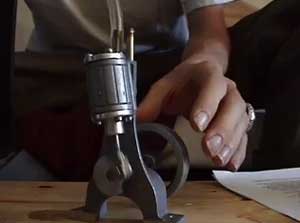
 Lorin from the Mojave desert built a steam-powered synthesizer. "This project started as a discussion with my friend Lewis Keller. I kinda joked about the absurdity of a steam powered synthesizer, and how strange and inefficient it would be. Well, the idea stuck in my head and a year later, here is the Parker Steam Synthesizer." It's really a steam oscillator, which uses a steam engine to drive a dynamo. The output from the dynamo oscillates and it produces a rough sine wave. I'm slightly disappointed that there's electricity and amplifiers involved. I was hoping for some kind of steam organ which could produce square waves, followed by a steam filter and a steam envelope generator. Still, it makes Eric's Tube Synth look a bit modern and 20th century, doesn't it?
Posted by Tom Whitwell. Story permalink. 5 comments Post a Comment
Lorin from the Mojave desert built a steam-powered synthesizer. "This project started as a discussion with my friend Lewis Keller. I kinda joked about the absurdity of a steam powered synthesizer, and how strange and inefficient it would be. Well, the idea stuck in my head and a year later, here is the Parker Steam Synthesizer." It's really a steam oscillator, which uses a steam engine to drive a dynamo. The output from the dynamo oscillates and it produces a rough sine wave. I'm slightly disappointed that there's electricity and amplifiers involved. I was hoping for some kind of steam organ which could produce square waves, followed by a steam filter and a steam envelope generator. Still, it makes Eric's Tube Synth look a bit modern and 20th century, doesn't it?
Posted by Tom Whitwell. Story permalink. 5 comments Post a Comment 

 Lukatoyboy writes from
 Just got back from Synth DIY 2006 in Cambridge, and posted this Flickr Set. Highlights for me were playing with and drooling over Alan McKerchar's incredible EMS Synthi-style Soundlab Mini Synth here, and Paul Maddox's nice digital/analog Defender synth here. Plus, I won an Akai S2000 in the raffle!
Posted by Tom Whitwell. Story permalink. 13 comments Post a Comment
Just got back from Synth DIY 2006 in Cambridge, and posted this Flickr Set. Highlights for me were playing with and drooling over Alan McKerchar's incredible EMS Synthi-style Soundlab Mini Synth here, and Paul Maddox's nice digital/analog Defender synth here. Plus, I won an Akai S2000 in the raffle!
Posted by Tom Whitwell. Story permalink. 13 comments Post a Comment
 I'm about to head off to Synth DIY UK, so there's just time to post this fine picture of Mike from Swinging Tasty Bag's splendid Nord Lead 2X birthday cake. More pictures in this gallery. Previous synth cakes here. (Thanks, Circuit Master)
Posted by Tom Whitwell. Story permalink. 0 comments Post a Comment
I'm about to head off to Synth DIY UK, so there's just time to post this fine picture of Mike from Swinging Tasty Bag's splendid Nord Lead 2X birthday cake. More pictures in this gallery. Previous synth cakes here. (Thanks, Circuit Master)
Posted by Tom Whitwell. Story permalink. 0 comments Post a Comment
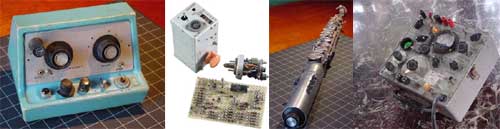 FMass writes: "Last night I was watching The Andromeda Strain, this seminal sci-fi movie from 1971. I was amazed by the soundtrack and this morning I went to check Gil Melle's website. I found this collection of home built instruments that I have to share with you right away!" Above, left to right: 'Electar 3', 'Wireless Synth', 'Tome VI', 'White Noise'. Gil was born in 1931 and got into the jazz and art scenes when he was a teenager: "When synthesizers were not available commercially, Mellé built them from scratch, and played... with the world's first all-electronic jazz group, 'Gil Mellé and the Electronauts.'" If you want to buy the 'Andromeda Strain' soundtrack on vinyl, it's a bit expensive (that's eBay item #2568002811).
Posted by Tom Whitwell. Story permalink. 3 comments Post a Comment
FMass writes: "Last night I was watching The Andromeda Strain, this seminal sci-fi movie from 1971. I was amazed by the soundtrack and this morning I went to check Gil Melle's website. I found this collection of home built instruments that I have to share with you right away!" Above, left to right: 'Electar 3', 'Wireless Synth', 'Tome VI', 'White Noise'. Gil was born in 1931 and got into the jazz and art scenes when he was a teenager: "When synthesizers were not available commercially, Mellé built them from scratch, and played... with the world's first all-electronic jazz group, 'Gil Mellé and the Electronauts.'" If you want to buy the 'Andromeda Strain' soundtrack on vinyl, it's a bit expensive (that's eBay item #2568002811).
Posted by Tom Whitwell. Story permalink. 3 comments Post a Comment
 Every few weeks, I get an email from someone saying "You should post something about Bhajis Loops. It's amazing!" It's a studio-in-a-box which runs on Palm handhelds. I've written about it a couple of times . So, finally inspired by this thread full of more happy users, I emailed Olivier, who told me (roughly) "Get a Tungsten T3. They've got a clever memory thing, they're cheap, and they're cool". So I did. Mine came with a Wifi card for £85, some go for £60. The software is $27, and you can buy 1gb SD cards for £10 on the 'bay.
 Zachary Vex's latest (well, March 2006) invention is the Ringtone. Unfortunately, it won't make everything you play sound like the Crazy Frog. It's a ring modulator with the carrier signal coming from an 8 step sequencer. That sounds like blah blah science blah until you watch this [QT] wonderful demo video. I was so inspired, I spent a whole 25 minutes making this Nord G2 patch based on the pedal, which doesn't sound or look nearly as cool, but doesn't cost $349, either...
Posted by Tom Whitwell. Story permalink. 6 comments Post a Comment
Zachary Vex's latest (well, March 2006) invention is the Ringtone. Unfortunately, it won't make everything you play sound like the Crazy Frog. It's a ring modulator with the carrier signal coming from an 8 step sequencer. That sounds like blah blah science blah until you watch this [QT] wonderful demo video. I was so inspired, I spent a whole 25 minutes making this Nord G2 patch based on the pedal, which doesn't sound or look nearly as cool, but doesn't cost $349, either...
Posted by Tom Whitwell. Story permalink. 6 comments Post a Comment
 If you're stupid, there are amazing bargains to be had on Chinese Ebay. Item #320009394191 purports to be a 'RARE!!' Buchla 100 Modular Synth. The auction ended recently, perhaps because the 'Buy it Now' price was 8,000 Chinese Yuan, or £542. Yes, the seller has zero feedback (and the last picture is the back end of some home A/V amp). If your tastes are more modern, how about #320009813151 - a Clavia Nord Stage with a 'buy it now' of £94.
 Chia-Ying Lee is writing a thesis about Sonic Graffiti, and blogging along the way. At the moment it's a stream of more-or-less random ideas, including his 'Sound Cap' - which looks like the top of a spray paint can but can record, loop and playback sound. (via the splendid new Palm Sounds blog)
Posted by Tom Whitwell. Story permalink. 9 comments Post a Comment
Chia-Ying Lee is writing a thesis about Sonic Graffiti, and blogging along the way. At the moment it's a stream of more-or-less random ideas, including his 'Sound Cap' - which looks like the top of a spray paint can but can record, loop and playback sound. (via the splendid new Palm Sounds blog)
Posted by Tom Whitwell. Story permalink. 9 comments Post a Comment
 I feel really old looking at the Numark D² Director. I have vinyl and Technics SL1200 decks which actually spin round. This thing has a USB port on the front, two on the back, a vast LCD screen which shows waveforms. You can bring your set on an iPod or a USB hard drive, then plug a USB keyboard into the thing to help you search for songs. You can record your mix back onto the hard drive. Numark say the aim is "ultimately simplifying the DJ performance experience." All this is just $799, which is significantly cheaper than a pair of SL1200s. Has the world gone mad?
 There's a typically baffling/silly interview with Aphex Twin in this month's Future Music magazine. When asked for a kit list, he says: "Sure. Raveolution 309, the Raven Max, MC-909 limited edition, Quasimidi Van Helden, MAM Freebass 383, Roland DJ-70, E-15, SP-808, Akai S3200, Behringer MX602A and all the Behringer effects that copy other things." When he's asked which software he uses, he says "UPIC by Xenakis puts almost everything else to shame. It's under 1mb and it shits on everyone." UPIC was a '70s experimental French system developed by Greek composer Iannis Xenakis, which is based on drawing on a graphics tablet. It's somehow connected with CCMIX, where they talk about it running on a Windows 98 system. UPIC seems to have developed into Iannix, which you can download from this page. He also talks about liking Ableton Live, but preferring LiveSlice for beat editing/stretching. He uses Etymotic Research headphones. My favourite Aphex Twin track ever is the demo version of Windowlicker, where you can hear that the whole track is put together with samples of him singing.
Posted by Tom Whitwell. Story permalink. 72 comments Post a Comment
There's a typically baffling/silly interview with Aphex Twin in this month's Future Music magazine. When asked for a kit list, he says: "Sure. Raveolution 309, the Raven Max, MC-909 limited edition, Quasimidi Van Helden, MAM Freebass 383, Roland DJ-70, E-15, SP-808, Akai S3200, Behringer MX602A and all the Behringer effects that copy other things." When he's asked which software he uses, he says "UPIC by Xenakis puts almost everything else to shame. It's under 1mb and it shits on everyone." UPIC was a '70s experimental French system developed by Greek composer Iannis Xenakis, which is based on drawing on a graphics tablet. It's somehow connected with CCMIX, where they talk about it running on a Windows 98 system. UPIC seems to have developed into Iannix, which you can download from this page. He also talks about liking Ableton Live, but preferring LiveSlice for beat editing/stretching. He uses Etymotic Research headphones. My favourite Aphex Twin track ever is the demo version of Windowlicker, where you can hear that the whole track is put together with samples of him singing.
Posted by Tom Whitwell. Story permalink. 72 comments Post a Comment
 This year's Synth-DIY UK meet is on July 29th at Robinson College, Cambridge. It's open to the public - just stroll up and see the greatest celebration of synth geekery on earth, if pictures of previous years are to be believed: 2005, 2004, 2003. See you there!
Posted by Tom Whitwell. Story permalink. 2 comments Post a Comment
This year's Synth-DIY UK meet is on July 29th at Robinson College, Cambridge. It's open to the public - just stroll up and see the greatest celebration of synth geekery on earth, if pictures of previous years are to be believed: 2005, 2004, 2003. See you there!
Posted by Tom Whitwell. Story permalink. 2 comments Post a Comment
 In Sao Paolo, Brazil, Marcelo Giangrande makes MG amps and effects pedals, which you can buy (for $$$$$) at Pedal Geek or the wonderful Vintage & Rare Guitars. I like the sound of the pink 'That's Echo Folks' analog delay pedal, which comes with a photoelectric sensor on the end of a cable (not unlike this). The light sensor controls delay time, which must make for extreme wierdness. It's also hard not to love the Louis Vuitton-style Pub guitar amp.
Posted by Tom Whitwell. Story permalink. 6 comments Post a Comment
In Sao Paolo, Brazil, Marcelo Giangrande makes MG amps and effects pedals, which you can buy (for $$$$$) at Pedal Geek or the wonderful Vintage & Rare Guitars. I like the sound of the pink 'That's Echo Folks' analog delay pedal, which comes with a photoelectric sensor on the end of a cable (not unlike this). The light sensor controls delay time, which must make for extreme wierdness. It's also hard not to love the Louis Vuitton-style Pub guitar amp.
Posted by Tom Whitwell. Story permalink. 6 comments Post a Comment
 I just spend 20 minutes making this image for an Engadget story which I then decided not to write. I don't need to tell you what it means, but I thought you'd enjoy it. The skull & crossbones is explained here. Obviously Roland did make a 404 later on, but not until their 'old rope' period.
Posted by Tom Whitwell. Story permalink. 10 comments Post a Comment
I just spend 20 minutes making this image for an Engadget story which I then decided not to write. I don't need to tell you what it means, but I thought you'd enjoy it. The skull & crossbones is explained here. Obviously Roland did make a 404 later on, but not until their 'old rope' period.
Posted by Tom Whitwell. Story permalink. 10 comments Post a Comment
 An Australian firm called Yogurt Activeculture sells a $50 yoga mat featuring what looks like a nice '70s strat. But it's more than just a cool picture. Oh yes: "Certain lights or sounds can stimulate emotional, mental, physical or spiritual responses in our bodies. Each of the 6 spinal chakra centers corresponds to a particular colour and musical note. Regular adjustments of the chakra centers helps keep our organs functioning properly. When they are balanced, your energy or life force flows freely. Stay tuned." It's also ribbed on one side. (Thanks to Mikey, whose new book is out now, via cool hunting)
Posted by Tom Whitwell. Story permalink. 2 comments Post a Comment
An Australian firm called Yogurt Activeculture sells a $50 yoga mat featuring what looks like a nice '70s strat. But it's more than just a cool picture. Oh yes: "Certain lights or sounds can stimulate emotional, mental, physical or spiritual responses in our bodies. Each of the 6 spinal chakra centers corresponds to a particular colour and musical note. Regular adjustments of the chakra centers helps keep our organs functioning properly. When they are balanced, your energy or life force flows freely. Stay tuned." It's also ribbed on one side. (Thanks to Mikey, whose new book is out now, via cool hunting)
Posted by Tom Whitwell. Story permalink. 2 comments Post a Comment
 As part of the Futuresonic festival, the Instrument exhibition, at the Museum of Science and Industry in Castlefield, Manchester, is a bit like Music Thing Live. You can see the wonderful Scrambled Hackz, the so-weird-I-never-got-round-to-posting-it iLog, the first UK performance by Toshio Iwai with his Tenori-On. Best of all, Peter Hindle will be showing his Duelling Etch-a-Sketch project. The exhibition runs from 20-29th July, with the Tenori-On show on the 21st. Full details on the very trendy and hard to navigate website here. (Thanks, Sacha)
Posted by Tom Whitwell. Story permalink. 2 comments Post a Comment
As part of the Futuresonic festival, the Instrument exhibition, at the Museum of Science and Industry in Castlefield, Manchester, is a bit like Music Thing Live. You can see the wonderful Scrambled Hackz, the so-weird-I-never-got-round-to-posting-it iLog, the first UK performance by Toshio Iwai with his Tenori-On. Best of all, Peter Hindle will be showing his Duelling Etch-a-Sketch project. The exhibition runs from 20-29th July, with the Tenori-On show on the 21st. Full details on the very trendy and hard to navigate website here. (Thanks, Sacha)
Posted by Tom Whitwell. Story permalink. 2 comments Post a Comment
 Yes, it looks like a photoshop prank, but this is Line6's new Toneport KB37. It's like a guitar amp designer* who'd never seen a MIDI keyboard decided to have a go anyway. It's nice that he couldn't resist throwing in some VU meters, next to those big silver amp knobs. He must have met Rick Wakeman sometime in the '70s, because there are some little Moog knobs in the middle, then maybe his son told him right at the end that keyboards have pitch/mod wheels, so he stuck them there at the back. Anyway, it's a Toneport interface, with a MIDI keyboard. No price yet, available in the autumn. Line6 have been very busy at Summer NAMM: Gearbox Plugin is a AU/VST version of the sounds from a PodXT, and the Floor Pod sounds like a cut-down PodXT Live - a little multi-effects pedal, sorry "Affordable Tone Solution".
 Roland just announced this at Summer NAMM. It's a four track digital recorder, records to SD card, built in drums and effects. Nothing very special, no phantom power, but... SHINY!
Posted by Tom Whitwell. Story permalink. 12 comments Post a Comment
Roland just announced this at Summer NAMM. It's a four track digital recorder, records to SD card, built in drums and effects. Nothing very special, no phantom power, but... SHINY!
Posted by Tom Whitwell. Story permalink. 12 comments Post a Comment
 Full details of Ableton's Live 6 are up - now allows video import, more effects, and "Universal Instrument Library with comprehensive collection of instruments sampled at supreme fidelity" all for $599. UPDATE: Links wonky (before the official announcement) - try here...
Posted by Tom Whitwell. Story permalink. 5 comments Post a Comment
Full details of Ableton's Live 6 are up - now allows video import, more effects, and "Universal Instrument Library with comprehensive collection of instruments sampled at supreme fidelity" all for $599. UPDATE: Links wonky (before the official announcement) - try here...
Posted by Tom Whitwell. Story permalink. 5 comments Post a Comment
 So, my friend Peter lent me his beloved TR-909 drum machine. After a bit of messing about, including tracking down an IEC C9 mains lead (from here), it's working, and is wonderful, particularly when messed about with. I already posted this G2 resonator patch, which is a copy of the effect in Ableton Live. Last night I made this patch (+ audio sample), in which the G2 tries to recreate the sounds it's getting at the inputs, using just a simple oscillator+filter. It sounds really wiggy, but somehow still a bit like a 909. Finally, and least interestingly, here [mp3] is the 909 coming through the spring reverb and VRS-23. Thanks, Peter!
Posted by Tom Whitwell. Story permalink. 4 comments Post a Comment
So, my friend Peter lent me his beloved TR-909 drum machine. After a bit of messing about, including tracking down an IEC C9 mains lead (from here), it's working, and is wonderful, particularly when messed about with. I already posted this G2 resonator patch, which is a copy of the effect in Ableton Live. Last night I made this patch (+ audio sample), in which the G2 tries to recreate the sounds it's getting at the inputs, using just a simple oscillator+filter. It sounds really wiggy, but somehow still a bit like a 909. Finally, and least interestingly, here [mp3] is the 909 coming through the spring reverb and VRS-23. Thanks, Peter!
Posted by Tom Whitwell. Story permalink. 4 comments Post a Comment
 Steve writes with exciting news: "I got an email today from Ray White, a old friend from the BBC Radiophonic Workshop. Ray was an engineer there for many years and has had this in-depth technical history of the Workshop up on the web for some time now. However, he has just added a gallery of pictures. As with so many unexplained phenomena, there are very few photos of the Radiophonic Workshop, but Ray’s collection is the most comprehensive to date. All the pics have notes, which are also very good." The pictures are fantastic and incredibly exotic. On a similar note, here has a great old clip of Liz Parker tweaking the enormous EMS Delaware (which people outside the workshop call a Synthi 100).
Posted by Tom Whitwell. Story permalink. 15 comments Post a Comment
Steve writes with exciting news: "I got an email today from Ray White, a old friend from the BBC Radiophonic Workshop. Ray was an engineer there for many years and has had this in-depth technical history of the Workshop up on the web for some time now. However, he has just added a gallery of pictures. As with so many unexplained phenomena, there are very few photos of the Radiophonic Workshop, but Ray’s collection is the most comprehensive to date. All the pics have notes, which are also very good." The pictures are fantastic and incredibly exotic. On a similar note, here has a great old clip of Liz Parker tweaking the enormous EMS Delaware (which people outside the workshop call a Synthi 100).
Posted by Tom Whitwell. Story permalink. 15 comments Post a Comment
 If you're in California before August 31, you might want to visit the Ojai Valley Museum, to see the Conloninpurple, 60 aluminium trumpets with midi-controlled solenoids whacking wooden blocks at the end of each. MT reader and supergeek Albert Behar helped set the thing up and recorded this mp3 of the thing in action. If you don't know Trimpin, then don't let his pretentious mono-name put you off. He an artist/musician who has invented many cool things, including "a gamelan whose iron bells are suspended in air by electronic magnets; a photo sensor prevents them from rising past a certain point, and since they don't touch anything, once rung they will sound with a phenomenally long decay."
Posted by Tom Whitwell. Story permalink. 5 comments Post a Comment
If you're in California before August 31, you might want to visit the Ojai Valley Museum, to see the Conloninpurple, 60 aluminium trumpets with midi-controlled solenoids whacking wooden blocks at the end of each. MT reader and supergeek Albert Behar helped set the thing up and recorded this mp3 of the thing in action. If you don't know Trimpin, then don't let his pretentious mono-name put you off. He an artist/musician who has invented many cool things, including "a gamelan whose iron bells are suspended in air by electronic magnets; a photo sensor prevents them from rising past a certain point, and since they don't touch anything, once rung they will sound with a phenomenally long decay."
Posted by Tom Whitwell. Story permalink. 5 comments Post a Comment
 For the grumpy laptop musician in your life... Fractal Spin's 'No, I am not checking my email, retard' t-shirt. For grumpy DJs, they also do 'This DJ takes requests' and who could live without 'I am totally incrementing this value with all my might'? Alternatively, there's this flashing monstrosity via Analog Industries.
Posted by Tom Whitwell. Story permalink. 7 comments Post a Comment
For the grumpy laptop musician in your life... Fractal Spin's 'No, I am not checking my email, retard' t-shirt. For grumpy DJs, they also do 'This DJ takes requests' and who could live without 'I am totally incrementing this value with all my might'? Alternatively, there's this flashing monstrosity via Analog Industries.
Posted by Tom Whitwell. Story permalink. 7 comments Post a Comment
 I'm not 100% convinced by their claim that it's "the world's first professional, portable, recording studio", but the Trinity DAW is certainly neat: A self-contained handheld unit with a screen, 500mhz processor, 128mb memory, 20gb hard drive, mic inputs with phantom power. It can run Audacity, which is an open-source audio editing program, a bit like Soundforge. It's $999, which isn't cheap, and obviously it's only renders at the moment (though they're billed as 'close up photos' on the website). More here at linuxdevices.com.
Posted by Tom Whitwell. Story permalink. 18 comments Post a Comment
I'm not 100% convinced by their claim that it's "the world's first professional, portable, recording studio", but the Trinity DAW is certainly neat: A self-contained handheld unit with a screen, 500mhz processor, 128mb memory, 20gb hard drive, mic inputs with phantom power. It can run Audacity, which is an open-source audio editing program, a bit like Soundforge. It's $999, which isn't cheap, and obviously it's only renders at the moment (though they're billed as 'close up photos' on the website). More here at linuxdevices.com.
Posted by Tom Whitwell. Story permalink. 18 comments Post a Comment
 Unless anyone can tell me otherwise, I think that the $135 "Custom Monulista Pick from Sweden", carved out of metorite rock, is the most expensive pick I've ever seen, part of a range from meteoriteguitarpicks.com.
It makes the fantastically high-tech Light Pick (which not only glows, but flashes with "seven different programmable beat patterns", seem very reasonable at $59. (Thanks to the rather splendid band The Shamblers)
Posted by Tom Whitwell. Story permalink. 7 comments Post a Comment
Unless anyone can tell me otherwise, I think that the $135 "Custom Monulista Pick from Sweden", carved out of metorite rock, is the most expensive pick I've ever seen, part of a range from meteoriteguitarpicks.com.
It makes the fantastically high-tech Light Pick (which not only glows, but flashes with "seven different programmable beat patterns", seem very reasonable at $59. (Thanks to the rather splendid band The Shamblers)
Posted by Tom Whitwell. Story permalink. 7 comments Post a Comment
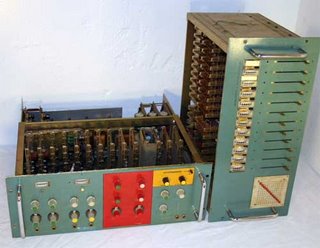 So, the Kraftwerk vocoder auction finished yesterday, and 60,000 hits on the auction page, it sold for $12,500 to a bidder from London called mjgooner. Presumably he's an Arsenal fan, and recently bought a nice-looking 1993 Alfa Romeo Spider, and a Bob Moog doll. If you're out there, mjgooner, get in touch and let us know how it feels!
Posted by Tom Whitwell. Story permalink. 5 comments Post a Comment
So, the Kraftwerk vocoder auction finished yesterday, and 60,000 hits on the auction page, it sold for $12,500 to a bidder from London called mjgooner. Presumably he's an Arsenal fan, and recently bought a nice-looking 1993 Alfa Romeo Spider, and a Bob Moog doll. If you're out there, mjgooner, get in touch and let us know how it feels!
Posted by Tom Whitwell. Story permalink. 5 comments Post a Comment
 Jesse writes: "You might like this: I built an accelerometer-equipped computer-controlled light-emitting battle helmet with MIDI in/out. I use it to perform live electronic music. Here [QT movie] it is in action." More music from Jesse here. Of course, Music Thing is your premier source for all helmet-related stories: guitars, synths, megaphones, mig,
Posted by Tom Whitwell. Story permalink. 0 comments Post a Comment
Jesse writes: "You might like this: I built an accelerometer-equipped computer-controlled light-emitting battle helmet with MIDI in/out. I use it to perform live electronic music. Here [QT movie] it is in action." More music from Jesse here. Of course, Music Thing is your premier source for all helmet-related stories: guitars, synths, megaphones, mig,
Posted by Tom Whitwell. Story permalink. 0 comments Post a Comment
 These are exciting times for people wanting to buy elderly studio gear with fashionable associations*. After Kraftwerk's vocoder and The Radiophonic Workshop's patchbay, comes Conny Plank's Entire Studio. Conny started his career as a sound man for Marlene Dietrich, before producing all the important krautrock albums by Kraftwerk, Neu! and Can. He died in 1987, but his studio continued, until his widow died on 1st June. Now the entire contents are up for sale in this auction, which seems slightly shambolic: "We will collect all the bids and offers over a couple of weeks and after a while the highest bidder will be the lucky one" but there is some great stuff on offer, including the hand-built console, some nice synths, and an instant collection of super-cool rack gear (1 and 2)... (Thanks, Samuel and Zanf) *I guess that's all of us, really.
Posted by Tom Whitwell. Story permalink. 1 comments Post a Comment
These are exciting times for people wanting to buy elderly studio gear with fashionable associations*. After Kraftwerk's vocoder and The Radiophonic Workshop's patchbay, comes Conny Plank's Entire Studio. Conny started his career as a sound man for Marlene Dietrich, before producing all the important krautrock albums by Kraftwerk, Neu! and Can. He died in 1987, but his studio continued, until his widow died on 1st June. Now the entire contents are up for sale in this auction, which seems slightly shambolic: "We will collect all the bids and offers over a couple of weeks and after a while the highest bidder will be the lucky one" but there is some great stuff on offer, including the hand-built console, some nice synths, and an instant collection of super-cool rack gear (1 and 2)... (Thanks, Samuel and Zanf) *I guess that's all of us, really.
Posted by Tom Whitwell. Story permalink. 1 comments Post a Comment
 Novation have just press released their uncomfortably-named XioSynth, an all-in-one synth, audio interface (with phantom power and mic preamp) and MIDI controller. It seems very small and cute - running on 6 AA batteries, with 8 voice polyphony, 200 presets, USB, a semi-weighted keyboard and built in effects (delay/reverb etc). Each voice has "3 Oscillators (17 waveforms + Noise), 1 filter of varying types, 2 LFOs". It has a 32-step gate sequencer - at the moment all it does is gate, but "we are already in discussion about other uses (e.g. modulating the filter) so it will be expanded in an OS update in the near future". Seems like great value at £229 (with a 49 key version at £299) - making it considerably cheaper than a MicroKorg, and with full-sized keys and more knobs. If you're loooking for a MIDI controller and would also like a little synth for deckchair tweaking, this could be for you.
Posted by Tom Whitwell. Story permalink. 8 comments Post a Comment
Novation have just press released their uncomfortably-named XioSynth, an all-in-one synth, audio interface (with phantom power and mic preamp) and MIDI controller. It seems very small and cute - running on 6 AA batteries, with 8 voice polyphony, 200 presets, USB, a semi-weighted keyboard and built in effects (delay/reverb etc). Each voice has "3 Oscillators (17 waveforms + Noise), 1 filter of varying types, 2 LFOs". It has a 32-step gate sequencer - at the moment all it does is gate, but "we are already in discussion about other uses (e.g. modulating the filter) so it will be expanded in an OS update in the near future". Seems like great value at £229 (with a 49 key version at £299) - making it considerably cheaper than a MicroKorg, and with full-sized keys and more knobs. If you're loooking for a MIDI controller and would also like a little synth for deckchair tweaking, this could be for you.
Posted by Tom Whitwell. Story permalink. 8 comments Post a Comment
 Seven reasons why I can't think of a nicer way to spend $100 than on a Thingamagoop mini synth from Bleep Labs:
 Loscha writes: "While not as cool as the Kraftwerk Vocoder, a jackfield from the BBC Radiophonic Workshop is still very neat..." Quite right: eBay item #120003732436 is a jackfield/patchbay which was apparently used in the legendary workshop before being shipped to Australia in the luggage of a former BBC engineer. As the vendor rightly says: "I can say, unashamedly, This is the best jackfield in the entire world. Period. You will never see anything like this again in your entire life." Unfortunately, you've just missed the chance to have something to plug it into. eBay item #250001734656 was a AKG BX20 spring reverb unit, "As used in the BBC Radiophonic Workshop", although it's not totally clear if that was this actual unit, or just the model. Either way, it went for a not unreasonable £470.
 Trogotronic sell hand-built and customised analog tube gear, like this 'hotrodded' Heathkit oscillator (which must be pretty hot for $600, but does look wonderful). They also do cheaper all-new noise boxes, and 'crude audio controllers' - I particularly like the look of the Iron Cross, which seems to be a bomb-proof old arcade joystick which switches between the four audio inputs. Would be handy for the Nord G2, which has 4 outputs. Speaking of the Nord G2, I just made this patch which you might enjoy. (Thanks, Devin, and previously on Get Lofi)
Posted by Tom Whitwell. Story permalink. 4 comments Post a Comment
Trogotronic sell hand-built and customised analog tube gear, like this 'hotrodded' Heathkit oscillator (which must be pretty hot for $600, but does look wonderful). They also do cheaper all-new noise boxes, and 'crude audio controllers' - I particularly like the look of the Iron Cross, which seems to be a bomb-proof old arcade joystick which switches between the four audio inputs. Would be handy for the Nord G2, which has 4 outputs. Speaking of the Nord G2, I just made this patch which you might enjoy. (Thanks, Devin, and previously on Get Lofi)
Posted by Tom Whitwell. Story permalink. 4 comments Post a Comment
