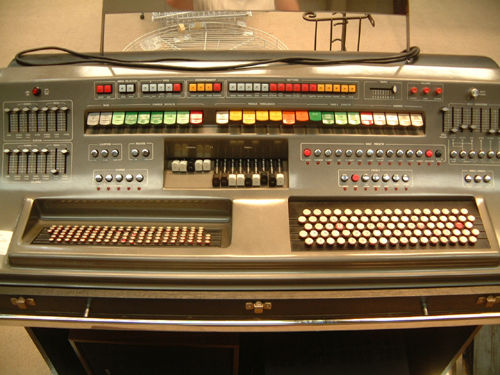
I just spotted this nice comment on my Engadget story about the Technos Axcel: Gocy writes: "I used to have a friend in the eighties that had one of these things, he was 17 and he had a fairlight II as well. He was the shadiest m.f. I've met and his fairlight used to crash all the time. Never knew how he got the cash. I remember this was like an astromic sum of 15,000 USD or more. I heard he got put in jail later for trying to stealing his own fairlight in some insurance scam. I remeber him trying to show me how the Acxel converted a sampled sound to synthes and it came out completly different or can I say turd like."
Posted by Tom Whitwell. Story permalink. 2 comments Post a Comment
I just spotted this nice comment on my Engadget story about the Technos Axcel: Gocy writes: "I used to have a friend in the eighties that had one of these things, he was 17 and he had a fairlight II as well. He was the shadiest m.f. I've met and his fairlight used to crash all the time. Never knew how he got the cash. I remember this was like an astromic sum of 15,000 USD or more. I heard he got put in jail later for trying to stealing his own fairlight in some insurance scam. I remeber him trying to show me how the Acxel converted a sampled sound to synthes and it came out completly different or can I say turd like."
Posted by Tom Whitwell. Story permalink. 2 comments Post a Comment 

 From the 'I didn't know that existed' department: EditorsKeys: Little stickers with the shortcuts for Pro Tools and Cubase. Certainly cheaper than the Pro Tools Custom Keyboard, which is $250. LogicKeyboard do a Cubase keyboard for €109.
Posted by Tom Whitwell. Story permalink. 5 comments Post a Comment
From the 'I didn't know that existed' department: EditorsKeys: Little stickers with the shortcuts for Pro Tools and Cubase. Certainly cheaper than the Pro Tools Custom Keyboard, which is $250. LogicKeyboard do a Cubase keyboard for €109.
Posted by Tom Whitwell. Story permalink. 5 comments Post a Comment
 JimG writes to let me know about Rock'n'Roll Confidential's Hall of Douchebags, a celebration of terrible band photos that will be very familiar to anyone who has ever worked on a music mag. I wonder how many Music Thing readers are in these pictures?
Posted by Tom Whitwell. Story permalink. 2 comments Post a Comment
JimG writes to let me know about Rock'n'Roll Confidential's Hall of Douchebags, a celebration of terrible band photos that will be very familiar to anyone who has ever worked on a music mag. I wonder how many Music Thing readers are in these pictures?
Posted by Tom Whitwell. Story permalink. 2 comments Post a Comment
 Tristram Cary and his cake reminded me of this page on the strange, lost-in-time website for EMS (it hasn't been updated since 1998). It's a collection of ads for various EMS synths. A few are missing, but look out for the Christmas special, and the picture of EMS founder Peter Zinovieff in a rustic idyll, synthesizing on batteries. Then there's the picture above, which is truly wonderful.
Posted by Tom Whitwell. Story permalink. 2 comments Post a Comment
Tristram Cary and his cake reminded me of this page on the strange, lost-in-time website for EMS (it hasn't been updated since 1998). It's a collection of ads for various EMS synths. A few are missing, but look out for the Christmas special, and the picture of EMS founder Peter Zinovieff in a rustic idyll, synthesizing on batteries. Then there's the picture above, which is truly wonderful.
Posted by Tom Whitwell. Story permalink. 2 comments Post a Comment
 Create Digital Music has a great story about Ben Dove and his String Thing project, which involves using vibrating steel bars, laser pointers and webcams to create a kind of digital cello. The legendary David Vorhaus tried to do a similar thing (based on a Double Bass) with his Kaleidophon, although he used ribbon controllers, made for him by the French Space Agency. His story is very entertainingly told in this Sound on Sound article. Obviously ribbon controllers don't glow in the dark, so Ben wins!
Posted by Tom Whitwell. Story permalink. 0 comments Post a Comment
Create Digital Music has a great story about Ben Dove and his String Thing project, which involves using vibrating steel bars, laser pointers and webcams to create a kind of digital cello. The legendary David Vorhaus tried to do a similar thing (based on a Double Bass) with his Kaleidophon, although he used ribbon controllers, made for him by the French Space Agency. His story is very entertainingly told in this Sound on Sound article. Obviously ribbon controllers don't glow in the dark, so Ben wins!
Posted by Tom Whitwell. Story permalink. 0 comments Post a Comment
 Thanks to Peter for discovering this - undoubtedly the coolest synth cake ever made (unless you know better). It's a EMS VCS3 (check out the silver Vernier dials, the joystick and the matrix panel full of candles!), that was made for the 80th birthday of Tristram Cary, one of the founders of EMS, who helped invent the VCS3. He's had a very cool career. He was a naval radar officer in WWII, when he started thinking about music made with tapes and electronics.
 After the war, he studied and made a living as a composer. He did music for film & tv, working on early Dr Who episodes and Quatermass and the Pit. In 1967 he founded the Electronic Music Studio at the Royal College of Music. In the '80s he moved to Australia and continued composing and wrote the great-sounding-but-very-expensive Illustrated Compendium of Musical Technology. He's now 80, and his neice has a blog, which is why we can all see his cool birthday cake... More on Tristram here. (And more synth cakes here)
Posted by Tom Whitwell. Story permalink. 8 comments Post a Comment
After the war, he studied and made a living as a composer. He did music for film & tv, working on early Dr Who episodes and Quatermass and the Pit. In 1967 he founded the Electronic Music Studio at the Royal College of Music. In the '80s he moved to Australia and continued composing and wrote the great-sounding-but-very-expensive Illustrated Compendium of Musical Technology. He's now 80, and his neice has a blog, which is why we can all see his cool birthday cake... More on Tristram here. (And more synth cakes here)
Posted by Tom Whitwell. Story permalink. 8 comments Post a Comment
 How I scoffed. Way back in October, when I first reported on the fantastic-sounding Lemur touch-screen control surface, I sniggered at their claim that they'd be for sale in 2005. Now, Create Digital Music is delighted to report that real, live, great-looking, for-sale, Lemurs are leaving the factory. In boxes! For $2495! It warms my heart. Meanwhile, Summer NAMM starts on July 22nd. Do you think Behringer will have their B-Control LM-1000 touch screen interface ($24.95) ready? (Joke!)
Posted by Tom Whitwell. Story permalink. 5 comments Post a Comment
How I scoffed. Way back in October, when I first reported on the fantastic-sounding Lemur touch-screen control surface, I sniggered at their claim that they'd be for sale in 2005. Now, Create Digital Music is delighted to report that real, live, great-looking, for-sale, Lemurs are leaving the factory. In boxes! For $2495! It warms my heart. Meanwhile, Summer NAMM starts on July 22nd. Do you think Behringer will have their B-Control LM-1000 touch screen interface ($24.95) ready? (Joke!)
Posted by Tom Whitwell. Story permalink. 5 comments Post a Comment
 Pixelsumo have another report from the RCA design show in London. Matthew Falla's connect..draw..remix uses conductive ink and a usb-connectable CD case. You get the CD home, plug it into your computer, then draw on the sleeve with a pencil, which allows you to remix the track. I suspect big labels are desperate to find ways to get people buying their plastic discs, so they'll be on the phone to Matthew very soon.
Posted by Tom Whitwell. Story permalink. 3 comments Post a Comment
Pixelsumo have another report from the RCA design show in London. Matthew Falla's connect..draw..remix uses conductive ink and a usb-connectable CD case. You get the CD home, plug it into your computer, then draw on the sleeve with a pencil, which allows you to remix the track. I suspect big labels are desperate to find ways to get people buying their plastic discs, so they'll be on the phone to Matthew very soon.
Posted by Tom Whitwell. Story permalink. 3 comments Post a Comment
 Omnisonic makes and sells theremins in old Star Wars lunchboxes. You get a choice of lunchbox, and the innards are made by Chuck Collins from Milwaukee.
Previous Star Wars coverage here and here. (Thanks, George)
Posted by Tom Whitwell. Story permalink. 5 comments Post a Comment
Omnisonic makes and sells theremins in old Star Wars lunchboxes. You get a choice of lunchbox, and the innards are made by Chuck Collins from Milwaukee.
Previous Star Wars coverage here and here. (Thanks, George)
Posted by Tom Whitwell. Story permalink. 5 comments Post a Comment
 Half-rack units are always a bit annoying - too small to fit in a proper rack, but not designed to sit on a tabletop. This page shows one neat way to mount a half-rack unit on a camera tripod. And in case you're wondering, that cool aluminium lap steel (slightly reminiscent of the Blaster Beam) is a Fouke Industrial Guitars Indy Rail, which costs just $350. (Thanks, David and Tim B)
Posted by Tom Whitwell. Story permalink. 0 comments Post a Comment
Half-rack units are always a bit annoying - too small to fit in a proper rack, but not designed to sit on a tabletop. This page shows one neat way to mount a half-rack unit on a camera tripod. And in case you're wondering, that cool aluminium lap steel (slightly reminiscent of the Blaster Beam) is a Fouke Industrial Guitars Indy Rail, which costs just $350. (Thanks, David and Tim B)
Posted by Tom Whitwell. Story permalink. 0 comments Post a Comment
 Rob writes: " Could this be the first synth cake? My mom baked it for me, a Paia-obsessed teenager, in 1978 or thereabouts. She raided my room for actual knobs and RCA connectors and stuck them in the icing." More synth cake action here and here.
Posted by Tom Whitwell. Story permalink. 0 comments Post a Comment
Rob writes: " Could this be the first synth cake? My mom baked it for me, a Paia-obsessed teenager, in 1978 or thereabouts. She raided my room for actual knobs and RCA connectors and stuck them in the icing." More synth cake action here and here.
Posted by Tom Whitwell. Story permalink. 0 comments Post a Comment
 Say what you like about Behringer and their super cheap music gear. This video [wmv] of a Behringer BCR2000 knob box dancing to acid house from a DSI Evolver is pure geek heaven. Stefan Trippler, we salute you! (Thanks, Jim)
Posted by Tom Whitwell. Story permalink. 10 comments Post a Comment
Say what you like about Behringer and their super cheap music gear. This video [wmv] of a Behringer BCR2000 knob box dancing to acid house from a DSI Evolver is pure geek heaven. Stefan Trippler, we salute you! (Thanks, Jim)
Posted by Tom Whitwell. Story permalink. 10 comments Post a Comment
 There's a pretty much endless supply of graduates doing weird shit with music, but I really like Andy Huntington's idea. His 'Beatbox' is a control panel, with five little satelites. The satelites have (I guess) little solenoids on the bottom. So, if you put them on something that makes a noise (like a pizza box, or a coffee cup), they can 'play' that object in time. The interface looks really nice - just tap the top of the satelite, and it repeats the rhythm. As always, the video explains it properly. You can see Beatbox at the RCA Show until 3rd
 Thanks Simon for letting me know that Basil Kirchin died on June 19th. I'd never heard of Basil until Simon's email arrived, but I'm glad I do now. He was a 100% paid up legend, inspiring people like Brian Eno and Nurse With Wound. He did things like being the first person to ever tour with their own PA system in the 1950s, and possibly the first (of countless) person to claim to be "writing music for an imaginary film". I'd very highly recommend this short history from Trunk Records, but this
quote (from an interview with Bob Stanley in 2003) seems to capture what he was about: "If you take the human voice and slow it down five octaves, immediately everything you can hear drops away. Take birdsong, all those harmonics you can't hear are brought down - sounds that human ears have never heard before. Little boulders of sound. In 1964 it was hard to capture. There was only reel to reel tape, and it took eight or nine years of my life. It was long and hard and painful. Now with the new technology you can hear these boulders of sound without changing the pitch, which is miraculous!"
Thanks Simon for letting me know that Basil Kirchin died on June 19th. I'd never heard of Basil until Simon's email arrived, but I'm glad I do now. He was a 100% paid up legend, inspiring people like Brian Eno and Nurse With Wound. He did things like being the first person to ever tour with their own PA system in the 1950s, and possibly the first (of countless) person to claim to be "writing music for an imaginary film". I'd very highly recommend this short history from Trunk Records, but this
quote (from an interview with Bob Stanley in 2003) seems to capture what he was about: "If you take the human voice and slow it down five octaves, immediately everything you can hear drops away. Take birdsong, all those harmonics you can't hear are brought down - sounds that human ears have never heard before. Little boulders of sound. In 1964 it was hard to capture. There was only reel to reel tape, and it took eight or nine years of my life. It was long and hard and painful. Now with the new technology you can hear these boulders of sound without changing the pitch, which is miraculous!"
 Steve Marshall (last heard of recording a witchdoctor in Mozambique) writes: "I've just started recording again for a new volume of Bilocation. I started with the Druids at Avebury (just a couple of miles from where I live). I recorded on the Solstice morning and put a new dummy head in the middle of their circle (that's the fluffy orange thing) while they performed their dawn ceremonies. It was a bloody good laugh, and there's some pics of it here. Find out more about Steve's work at bilocation.com.
Posted by Tom Whitwell. Story permalink. 1 comments Post a Comment
Steve Marshall (last heard of recording a witchdoctor in Mozambique) writes: "I've just started recording again for a new volume of Bilocation. I started with the Druids at Avebury (just a couple of miles from where I live). I recorded on the Solstice morning and put a new dummy head in the middle of their circle (that's the fluffy orange thing) while they performed their dawn ceremonies. It was a bloody good laugh, and there's some pics of it here. Find out more about Steve's work at bilocation.com.
Posted by Tom Whitwell. Story permalink. 1 comments Post a Comment
 Brian writes: "This is a bit special... He's not wrong. It's all handmade. The metalwork is magnesium alloy, melted down from an old alloy wheel. The wood is carved mahogany, and the single pickup slides up and down on two brass rails, controlled by the gear stick from an old tractor. The seller calls himself planecrazydude. Good work!
 I've never heard of the Theremin as a devotional instrument, but apparently it does happen: This
 Thanks to Ricky for sending me another [wmv video] incredible and horrific video of Michael Angelo. This clip really reminds me of some hideous porn video, right down to the expressions that Michael is pulling. Can't someone just build a guitar with an arpeggiator, and put an end to all this messing about?
Posted by Tom Whitwell. Story permalink. 66 comments Post a Comment
Thanks to Ricky for sending me another [wmv video] incredible and horrific video of Michael Angelo. This clip really reminds me of some hideous porn video, right down to the expressions that Michael is pulling. Can't someone just build a guitar with an arpeggiator, and put an end to all this messing about?
Posted by Tom Whitwell. Story permalink. 66 comments Post a Comment
 John writes: "Hi! The Synth-DIY list had a contest for best project of last year (better late than never, right?) and here are the results." The competition was known as the Soddy Awards, and the overall winner was, quite rightly, Ray Wilson's Mini Synth, which nearly inspired me to buy a soldering iron myself. I would also have voted for Rene Schmitz' awesome, glowing, perspex-fronted tube synth, stuffed with blue-glowing thyratrons...
Posted by Tom Whitwell. Story permalink. 0 comments Post a Comment
John writes: "Hi! The Synth-DIY list had a contest for best project of last year (better late than never, right?) and here are the results." The competition was known as the Soddy Awards, and the overall winner was, quite rightly, Ray Wilson's Mini Synth, which nearly inspired me to buy a soldering iron myself. I would also have voted for Rene Schmitz' awesome, glowing, perspex-fronted tube synth, stuffed with blue-glowing thyratrons...
Posted by Tom Whitwell. Story permalink. 0 comments Post a Comment
 While looking at Melodicas.com, I found this fantastically strange 'keyboard sitar', which they sell for $150. It's a little handmade Indian instrument. I love the way the keys get smaller as the notes get higher. Colin at MIT has just sold his Keyboard Sitar, but still has some details on this page, including this [mp3] recording. How does it sound? Awful!
Posted by Tom Whitwell. Story permalink. 4 comments Post a Comment
While looking at Melodicas.com, I found this fantastically strange 'keyboard sitar', which they sell for $150. It's a little handmade Indian instrument. I love the way the keys get smaller as the notes get higher. Colin at MIT has just sold his Keyboard Sitar, but still has some details on this page, including this [mp3] recording. How does it sound? Awful!
Posted by Tom Whitwell. Story permalink. 4 comments Post a Comment
 This (ancient but still funny) page explains how to mount a melodica (those little keyboard wind instruments that dub musicians use) in your car. As you drive, a funnel catches the wind and pushes it through the melodica, which you can then play on your dashboard: "The volume of the Carlodica is regulated by the gas pedal which also propels the vehicle forward. The faster you drive the louder it gets. For fixed dynamics, set the cruise control around 70 MPH. A beautiful tremolo effect can be achieved by accelerating and slamming on the breaks repeatedly."
 Alesis Micron owner Chris has a very understanding girlfriend. For his birthday party, she baked him this Micron shaped cake, complete with jelly buttons and sweetie knobs. The inside of the cake looks like a sponge with bits in it. Strangely enough, that's what the inside of a real Micron looks like. Let's hope that Chris and Ms Chris aren't planning to get married. (Thanks, Tim B)
Posted by Tom Whitwell. Story permalink. 0 comments Post a Comment
Alesis Micron owner Chris has a very understanding girlfriend. For his birthday party, she baked him this Micron shaped cake, complete with jelly buttons and sweetie knobs. The inside of the cake looks like a sponge with bits in it. Strangely enough, that's what the inside of a real Micron looks like. Let's hope that Chris and Ms Chris aren't planning to get married. (Thanks, Tim B)
Posted by Tom Whitwell. Story permalink. 0 comments Post a Comment
 Thanks to Mikey, Chris, Dave, Tim D, Tim B and Kate for letting me know about this awesome Pac Man guitar, with a flashing headstock (12 bulbs behind a sheet of white acrylic). You can order one yourself for $5,600, which does seem a little excessive. (via Make, Boing Boing, and Gizmodo)
Posted by Tom Whitwell. Story permalink. 2 comments Post a Comment
Thanks to Mikey, Chris, Dave, Tim D, Tim B and Kate for letting me know about this awesome Pac Man guitar, with a flashing headstock (12 bulbs behind a sheet of white acrylic). You can order one yourself for $5,600, which does seem a little excessive. (via Make, Boing Boing, and Gizmodo)
Posted by Tom Whitwell. Story permalink. 2 comments Post a Comment
 CASSETTE WEEK: Old 4-track portastudios are now very, very cheap on eBay, rarely selling for more than £50. Ancient 80s models are even cheaper. The Teac 144 was the first ever Portastudio, launched in 1979. It's a cool looking thing, with big analog VU meters and loads of knobs. But it is very old. The last three on eBay went for £16, £30 and £17. However, if the machine has a 'celebrity' past, it can be very different. this auction for a Portastudio owned by Martin Degville (seen here in the fur coat) from Sigue Sigue Sputnik (it "comes with a 4 track master of one of their sessions circa 1980") is currently selling for £162 - and it still hasn't beaten the reserve. I can only imagine how SSS must have sounded before Giorgio Moroder got hold of them. And yes, you read that right. £162!
Posted by Tom Whitwell. Story permalink. 9 comments Post a Comment
CASSETTE WEEK: Old 4-track portastudios are now very, very cheap on eBay, rarely selling for more than £50. Ancient 80s models are even cheaper. The Teac 144 was the first ever Portastudio, launched in 1979. It's a cool looking thing, with big analog VU meters and loads of knobs. But it is very old. The last three on eBay went for £16, £30 and £17. However, if the machine has a 'celebrity' past, it can be very different. this auction for a Portastudio owned by Martin Degville (seen here in the fur coat) from Sigue Sigue Sputnik (it "comes with a 4 track master of one of their sessions circa 1980") is currently selling for £162 - and it still hasn't beaten the reserve. I can only imagine how SSS must have sounded before Giorgio Moroder got hold of them. And yes, you read that right. £162!
Posted by Tom Whitwell. Story permalink. 9 comments Post a Comment
 What were
 When I was 14, playing gigs at school, we knew we were pro because we had real silver gaffa/duct tape to stick the cables to the stage (thanks, Peter!). If you're a real musician, you should probably invest in some 3M Nuclear-Grade Duct Tape, which is for "Use in nuclear power plants to seal end caps on stainless steel pipes, hold labels and signs on stainless steel pipes, and seal HVAC metal ductwork. Meets NRC (Nuclear Regulatory Commission) Guide 1.38." Available from the wonderful McMaster-Carr catalogue for $11.97 a roll.
Posted by Tom Whitwell. Story permalink. 1 comments Post a Comment
When I was 14, playing gigs at school, we knew we were pro because we had real silver gaffa/duct tape to stick the cables to the stage (thanks, Peter!). If you're a real musician, you should probably invest in some 3M Nuclear-Grade Duct Tape, which is for "Use in nuclear power plants to seal end caps on stainless steel pipes, hold labels and signs on stainless steel pipes, and seal HVAC metal ductwork. Meets NRC (Nuclear Regulatory Commission) Guide 1.38." Available from the wonderful McMaster-Carr catalogue for $11.97 a roll.
Posted by Tom Whitwell. Story permalink. 1 comments Post a Comment
 CASSETTE WEEK: Lots of people talk about building a tape-echo from an old cassette deck, but I've never seen it done as nicely as this from MZE-electroarts. The system seems to be based around two cassette decks frankensteined together, with a hi-fi graphic eq and spectrum analyser in the feedback path (nice touch!).
Posted by Tom Whitwell. Story permalink. 2 comments Post a Comment
CASSETTE WEEK: Lots of people talk about building a tape-echo from an old cassette deck, but I've never seen it done as nicely as this from MZE-electroarts. The system seems to be based around two cassette decks frankensteined together, with a hi-fi graphic eq and spectrum analyser in the feedback path (nice touch!).
Posted by Tom Whitwell. Story permalink. 2 comments Post a Comment
 It's hard not to shed a tear while reading this BBC report about the impending death of cassette tapes. Nobody mourned the passing of VHS tapes (too big, too complicated, too crappy), but cassettes lasted pretty well. All this week, we'll me mourning their passing - so send your stories. Previously on MT: Homemade DJ Cassette Decks, the strange world of German vintage cassette collectors, Cassette to USB drive hack, and the cassette museum.
Posted by Tom Whitwell. Story permalink. 8 comments Post a Comment
It's hard not to shed a tear while reading this BBC report about the impending death of cassette tapes. Nobody mourned the passing of VHS tapes (too big, too complicated, too crappy), but cassettes lasted pretty well. All this week, we'll me mourning their passing - so send your stories. Previously on MT: Homemade DJ Cassette Decks, the strange world of German vintage cassette collectors, Cassette to USB drive hack, and the cassette museum.
Posted by Tom Whitwell. Story permalink. 8 comments Post a Comment
 Bizarre ambient/medieval flash-powered music generator here, most notable for an interface in which the sun sets and the moon rises... (Thanks Tommy)
Posted by Tom Whitwell. Story permalink. 2 comments Post a Comment
Bizarre ambient/medieval flash-powered music generator here, most notable for an interface in which the sun sets and the moon rises... (Thanks Tommy)
Posted by Tom Whitwell. Story permalink. 2 comments Post a Comment
 Pietro writes to tell me about a this page where you can listen to a 1983 demo tape produced by the Serge synth company, with loads of music by various musicians recorded on huge modular systems. It's hissy, but great. More on Serge gear here, here and here.
Posted by Tom Whitwell. Story permalink. 2 comments Post a Comment
Pietro writes to tell me about a this page where you can listen to a 1983 demo tape produced by the Serge synth company, with loads of music by various musicians recorded on huge modular systems. It's hissy, but great. More on Serge gear here, here and here.
Posted by Tom Whitwell. Story permalink. 2 comments Post a Comment
 Yes, I've written about the Latronic Notron step sequencer before: Here and here, and every time someone points out that they're totally overhyped and not worth the money. Which I'm sure is true. This one is one of the original first run 'giant black toilet seat' design, for sale in Switzerland with bids starting at £995. (Thanks, 'Susan')
Posted by Tom Whitwell. Story permalink. 6 comments Post a Comment
Yes, I've written about the Latronic Notron step sequencer before: Here and here, and every time someone points out that they're totally overhyped and not worth the money. Which I'm sure is true. This one is one of the original first run 'giant black toilet seat' design, for sale in Switzerland with bids starting at £995. (Thanks, 'Susan')
Posted by Tom Whitwell. Story permalink. 6 comments Post a Comment
 The Dilletante's Dictionary is a handy dictionary of music tech terms, from A-DAM to Zero Crossing. It was written by Sandy Lerner, who founded Cisco Systems, then sold her share for $125million in 1990, before founding Urban Decay cosmetics, collecting a 6,000 book library of women's writing and giving vast amounts of money to animal charities.
 In the introduction, she says that the dictionary was written in Scotland in 1996, when she got into sound recording: "I was entering my third score of life and it was time for a career change; I do this every twenty years whether I need to or not. A dictionary appealed as it’s one thing to peruse the technical journals, but another to actually understand them. Having done the go-learn-everything- about-the-new-career- so-I-don’t-look-like- a-total-idiot thing before, I knew that the hardest thing to do is explain something you don’t really understand to someone else."
Posted by Tom Whitwell. Story permalink. 1 comments Post a Comment
In the introduction, she says that the dictionary was written in Scotland in 1996, when she got into sound recording: "I was entering my third score of life and it was time for a career change; I do this every twenty years whether I need to or not. A dictionary appealed as it’s one thing to peruse the technical journals, but another to actually understand them. Having done the go-learn-everything- about-the-new-career- so-I-don’t-look-like- a-total-idiot thing before, I knew that the hardest thing to do is explain something you don’t really understand to someone else."
Posted by Tom Whitwell. Story permalink. 1 comments Post a Comment
 VIDEO WEEK: Exactly 18 seconds into this [2.5mb WMV] guitar tapping tutorial video from metalmethod.com, this hairy dude, who is called Michael Angelo Batio, completely spazzes out in a way that puts Jim Motley to shame. It's alarming. Meanwhile, Brad from Brad Sucks has been learning tapping himself: "After years of not knowing how to do it and being too ashamed to ask, this Quicktime video taught me how to do the most wanky and weedly of guitar tricks." What's the synth-geek equivalent of tapping, and could someone send me a video of it? UPDATE: A new (and infinitely more hardcore) video of Michael HERE. UPDATE: Mr Battio is, according to one commenter who went to school with him, 50 years old.
Posted by Tom Whitwell. Story permalink. 70 comments Post a Comment
VIDEO WEEK: Exactly 18 seconds into this [2.5mb WMV] guitar tapping tutorial video from metalmethod.com, this hairy dude, who is called Michael Angelo Batio, completely spazzes out in a way that puts Jim Motley to shame. It's alarming. Meanwhile, Brad from Brad Sucks has been learning tapping himself: "After years of not knowing how to do it and being too ashamed to ask, this Quicktime video taught me how to do the most wanky and weedly of guitar tricks." What's the synth-geek equivalent of tapping, and could someone send me a video of it? UPDATE: A new (and infinitely more hardcore) video of Michael HERE. UPDATE: Mr Battio is, according to one commenter who went to school with him, 50 years old.
Posted by Tom Whitwell. Story permalink. 70 comments Post a Comment
 Andy and 'None None' both write to praise Paia, vendors of DIY synth kits since 1967. On the left side of this yellow box is a Paia Fatman analog synth. On the right is "a bunch of audio processors", all built into a drill case by Retrosonic, whose whole site is full of wonders. Paia also sell kits for cool things like spring reverbs and ribbon controllers. I wonder how Mr Champagne got on with his.
Posted by Tom Whitwell. Story permalink. 7 comments Post a Comment
Andy and 'None None' both write to praise Paia, vendors of DIY synth kits since 1967. On the left side of this yellow box is a Paia Fatman analog synth. On the right is "a bunch of audio processors", all built into a drill case by Retrosonic, whose whole site is full of wonders. Paia also sell kits for cool things like spring reverbs and ribbon controllers. I wonder how Mr Champagne got on with his.
Posted by Tom Whitwell. Story permalink. 7 comments Post a Comment
 DJ
DJ
 VIDEO WEEK:Jim Motley is the UK Product Manager for TC Electronic. At tradeshows, he does demonstrations. He's not quite as funny as the Prodikeys "this is rock'n'roll" guy [wmv video] but he's pretty ripe. He's described here as "an absolute spaz", which is a little harsh. I think his finest hour is this [QT] one, because he sings and dances. There's more Jim here. If you've got any more funny tradeshow videos, please let me know.
Posted by Tom Whitwell. Story permalink. 14 comments Post a Comment
VIDEO WEEK:Jim Motley is the UK Product Manager for TC Electronic. At tradeshows, he does demonstrations. He's not quite as funny as the Prodikeys "this is rock'n'roll" guy [wmv video] but he's pretty ripe. He's described here as "an absolute spaz", which is a little harsh. I think his finest hour is this [QT] one, because he sings and dances. There's more Jim here. If you've got any more funny tradeshow videos, please let me know.
Posted by Tom Whitwell. Story permalink. 14 comments Post a Comment
 VIDEO WEEK: With 323 votes, the winner of the Daft Punk Aibo Dance Competition is this creature from Barcelona, doing an Olivia Newton John inspired number. But for real robot porn, check out 'Hooker' from Berlin. Hot!
Posted by Tom Whitwell. Story permalink. 4 comments Post a Comment
VIDEO WEEK: With 323 votes, the winner of the Daft Punk Aibo Dance Competition is this creature from Barcelona, doing an Olivia Newton John inspired number. But for real robot porn, check out 'Hooker' from Berlin. Hot!
Posted by Tom Whitwell. Story permalink. 4 comments Post a Comment
 VIDEO WEEK: Thanks to 'Susan' in
 Kaden (do check out his website) writes: "Three words: Shark. Shaped. Guitar" [link]
Posted by Tom Whitwell. Story permalink. 2 comments Post a Comment
Kaden (do check out his website) writes: "Three words: Shark. Shaped. Guitar" [link]
Posted by Tom Whitwell. Story permalink. 2 comments Post a Comment
 Some very, very high-end synth porn here. It's Vince Clarke's synth collection - from endless giant modulars to his BBC Micro, still running UMI sequencing software. The pictures are from veteran producer Gareth Jones's site. (thanks Ben)
Posted by Tom Whitwell. Story permalink. 5 comments Post a Comment
Some very, very high-end synth porn here. It's Vince Clarke's synth collection - from endless giant modulars to his BBC Micro, still running UMI sequencing software. The pictures are from veteran producer Gareth Jones's site. (thanks Ben)
Posted by Tom Whitwell. Story permalink. 5 comments Post a Comment
 It's been linked all over the place, but I only just saw this [wmv] clip of David 'that guy from the VW advert' Bernal dancing (he's the third kid on. You'll know it's him when the crowd go apeshit). There's a great interview with David here at kottke.org. Turns out he's a big Warp Records fan. (from Kingblind)
Posted by Tom Whitwell. Story permalink. 8 comments Post a Comment
It's been linked all over the place, but I only just saw this [wmv] clip of David 'that guy from the VW advert' Bernal dancing (he's the third kid on. You'll know it's him when the crowd go apeshit). There's a great interview with David here at kottke.org. Turns out he's a big Warp Records fan. (from Kingblind)
Posted by Tom Whitwell. Story permalink. 8 comments Post a Comment
 It makes absolutely no sense to me, but this website has loads of incredibly clever stuff about turning the Fibonacci Sequence into MIDI files which you can download, and baffling "Spectral and Roughness Analysis" of any audio file you want to upload. (via Make)
Posted by Tom Whitwell. Story permalink. 2 comments Post a Comment
It makes absolutely no sense to me, but this website has loads of incredibly clever stuff about turning the Fibonacci Sequence into MIDI files which you can download, and baffling "Spectral and Roughness Analysis" of any audio file you want to upload. (via Make)
Posted by Tom Whitwell. Story permalink. 2 comments Post a Comment
 Picture the scene: You're at the 2005 National Association of Broadcasters show in Las Vegas. Barely able to focus after half a dozen yards of frozen marguerita, you stumble across a stand selling sound effects CDs. You spot one called "Guns" and read the back: "Choose from more than 60 different guns, rocket launchers and hand grenades. This library includes North American and European models, vintage black powder guns, World War I and modern weapons, and full size military munitions". Then you listen to this [mp3] awesome preview. $500 for three CDs! Great! I'll take 'em!
 Dan writes with jaw agape: "Do you believe this eBay auction? Someone paid $120 US for a Casio VL-1 / V-Tone. I'm sure it's nice, though." The auction is a masterclass in eBay writing: "This is an absolutely superb, virtually mint example of this classic analogue mono synth / calculator". The buyer looks like a serious collector (they recently paid $5,450 for a 1965 Fender Precision) - or perhaps an engineer from a studio spending someone else's money. As far as I'm concerned, he (or she) is just someone inspired by my Engadget column from a few weeks back.
Posted by Tom Whitwell. Story permalink. 11 comments Post a Comment
Dan writes with jaw agape: "Do you believe this eBay auction? Someone paid $120 US for a Casio VL-1 / V-Tone. I'm sure it's nice, though." The auction is a masterclass in eBay writing: "This is an absolutely superb, virtually mint example of this classic analogue mono synth / calculator". The buyer looks like a serious collector (they recently paid $5,450 for a 1965 Fender Precision) - or perhaps an engineer from a studio spending someone else's money. As far as I'm concerned, he (or she) is just someone inspired by my Engadget column from a few weeks back.
Posted by Tom Whitwell. Story permalink. 11 comments Post a Comment
 Sean writes: "A guy is selling a 'Mobile Recording Studio', built into possibly the ugliest box I've ever seen - and he says it cost him £1000 to have it built? Are they really car speakers in there?
 What is it with Germany and amazing vintage drum machines? The same guy who sold the Wersi CX-1 a few weeks back now has this Sisme/Godwin Drum Computer for sale. I don't know much about it, but it looks incredible. Currently just 1 Euro, and he will ship outside Germany...
Posted by Tom Whitwell. Story permalink. 0 comments Post a Comment
What is it with Germany and amazing vintage drum machines? The same guy who sold the Wersi CX-1 a few weeks back now has this Sisme/Godwin Drum Computer for sale. I don't know much about it, but it looks incredible. Currently just 1 Euro, and he will ship outside Germany...
Posted by Tom Whitwell. Story permalink. 0 comments Post a Comment
 Bill Wesley from San Diego has taken the 'Thumb Piano' (which is a bad name for a bunch of different African instruments, including the Kalimba) and pushed it. His Array M'Bira has up to 150 indivdually made and tuned carbon steel tines, soundboards made from various exotic woods, and lots of nice engraving. That's probably why they cost from $1,600 to $2,400 (or more for custom woods). The tines are tuned according to this fantastically complicated scheme. There's also some kind of MIDI controller, but I can't find out much about that from the site. (Thanks Carl)
Posted by Tom Whitwell. Story permalink. 4 comments Post a Comment
Bill Wesley from San Diego has taken the 'Thumb Piano' (which is a bad name for a bunch of different African instruments, including the Kalimba) and pushed it. His Array M'Bira has up to 150 indivdually made and tuned carbon steel tines, soundboards made from various exotic woods, and lots of nice engraving. That's probably why they cost from $1,600 to $2,400 (or more for custom woods). The tines are tuned according to this fantastically complicated scheme. There's also some kind of MIDI controller, but I can't find out much about that from the site. (Thanks Carl)
Posted by Tom Whitwell. Story permalink. 4 comments Post a Comment
 So, it looks like Meg White was playing a set of Chromatic Desk Bells, mounted on a big bit of wood. At just $77 for an octave (13 notes, two Cs), I imagine these things must make a pretty impressive racket. If you're feeling superfly, go for the $120 20 note set. Props also to the anonymous poster who suggested she was playing a Bonang, an enormous Javanese instrument which does look a bit similar.
Posted by Tom Whitwell. Story permalink. 3 comments Post a Comment
So, it looks like Meg White was playing a set of Chromatic Desk Bells, mounted on a big bit of wood. At just $77 for an octave (13 notes, two Cs), I imagine these things must make a pretty impressive racket. If you're feeling superfly, go for the $120 20 note set. Props also to the anonymous poster who suggested she was playing a Bonang, an enormous Javanese instrument which does look a bit similar.
Posted by Tom Whitwell. Story permalink. 3 comments Post a Comment